Showing posts with label china. Show all posts

Anglo-Japanese Treaty

Anglo-Japanese Treaty

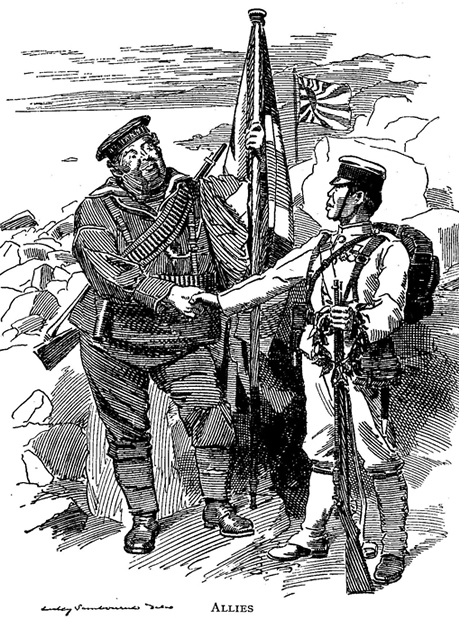
The Anglo-Japanese treaty was signed between Lord Lansdowne (1845–1927), the British foreign secretary, and Hayashi Tadasu (1850–1913), the minister of Japan, on January 30, 1902, in London to create an alliance scheduled to last five years. Its terms gave Japan an equal partnership with a great power of the Western world.

The purpose of this first military agreement was stabilization and peace in northeast Asia. On Japan's side it was to prevent Russian expansionism in northeast Asia, and on Great Britain's side it protected British interests and its commerce in China.

Japan felt vulnerable due to Russian influence in Manchuria and interest in Korea. The Anglo-Japanese treaty allowed Japan to become a more powerful player in world diplomacy and in negotiations with Russia.

It allowed Japan to go to war against Russia in February 1904 and to ask for financial support from Great Britain. The Russo-Japanese War (1904–05) astounded the world because of the success of Japan. It ended the menace of Russia and helped Great Britain to play a greater role in Europe.

The revision of the Anglo-Japanese treaty was signed on August 12, 1905, between Lansdowne and Hayashi in Lansdowne's residence. The new terms included an extension of the area covered by the alliance to include India, British recognition of Japan's right to control Korea, and Japan's recognition of Great Britain's right to safeguard her possessions in India.

It also provided that in the event of any unprovoked attack neither party would come to the assistance of its ally. The alliance would remain in force for the following 10 years. The new terms showed Japan had increased its status in international society after winning the war over Russia.

The third Anglo-Japanese alliance agreement was negotiated in 1911 after Japan's annexation of Korea. Important changes concerned the deletion of the articles related to Korea and India and the extension of the alliance for 10 more years. The second revision accommodated Japan's annexation of Korea but also, at Britain's request, excluded the United States from the region. The alliance enabled Japan to participate in World War I as a British ally.

With World War I beginning in the summer of 1914 and with political changes in China, Anglo-Japanese relations entered a new era. The new situation in the Far East restulted in a closer relationship between the United States and China.

With the outbreak of the Russian Revolution and Civil War in 1917, U.S. participation in the war, and later the publication of President Woodrow Wilson's Fourteen Points on how to end the war, the groundwork was set for new national relations.

These new circumstances brought changes in Anglo-Japanese relations after World War I. Great Britain no longer feared the Russian expansion in China and had developed a close relationship with the United States. The United States had also started to view Japan as a competitor in East Asia. The problems of China were also affecting international politics.

As a result, the United States decided to call a conference whose aim was to prevent expansion in China. At the Washington Conference (1921–22) Anglo-American cooperation in Asia allowed the United States to force Japan to accede to an end of the Anglo-Japanese alliance. The official termination of the alliance took place on August 17, 1923.

Anti-Communist Encirclement Campaigns in China (1930 - 1934)

Chiang Kai-shek and his army 1933

In 1923 Sun Yat-sen (d. 1925), leader of the Kuomintang (KMT), or Chinese Nationalist Party, then out of power, made an agreement with Adolf Joffe, Soviet representative in China.

It became the basis of an entente between the KMT and the Russian Communist government whereby Russia sent advisers to help Sun and the KMT and allowed Chinese students to go to Russia to study. It also allowed members of the newly formed Chinese Communist Party (CCP) to join the KMT. This entente ushered in what became known as the first united front.

In 1926 the KMT launched a campaign called the Northern Expedition, commanded by Sun's lieutenant Chiang Kai-shek, to oust the warlords and unite China. Its spectacular success led to a power struggle between the Soviet-supported CCP and the anti-CCP faction of the KMT, led by Chiang.


Chiang won the showdown, expelling the Soviet advisers, purging the CCP, and then defeating most of the remaining warlords. Between 1928 and 1937 the KMT ruled from China's new capital, Nanjing (Nanking), under an unstable coalition led by Chiang.

Remnant CCP members fled to the mountains in Jiangsu (Kiangsu) province, where they established the Chinese Soviet Republic with its capital at Ruijin (Juichin). Chiang's new government was too preoccupied with dissident KMT leaders to worry about the CCP between 1928 and 1930, which allowed the CCP to expand to parts of Hunan, Hubei (Hupei), Anhui (Anhwei), and Fujian (Fukien) provinces and increase its army to 120,000 men plus paramilitary units.

Between 1930 and 1934 the Nationalist government launched five encirclement and extermination campaigns against the Communists (First Campaign, from fall 1930 to April 1931; Second Campaign, from February to May 1931; Third Campaign, from July to September 1931; Fourth Campaign, from January to April 1933; and Fifth Campaign, from October 1933 to October 1934).

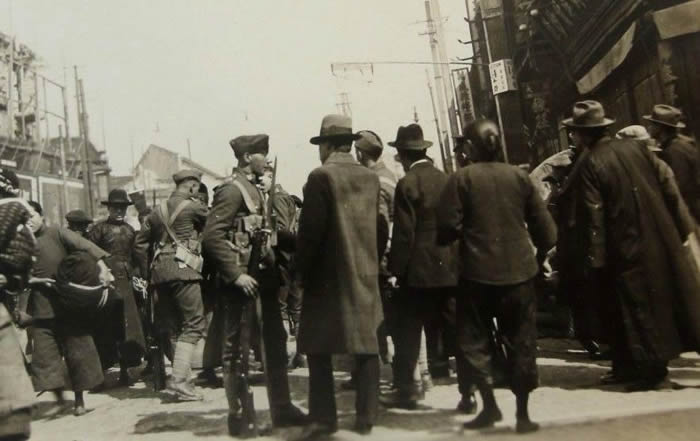
soldiers are looking for Communists

The first four campaigns failed because they were commanded by generals of varying ability and loyalty, because the government simultaneously had to deal with more serious revolts by dissident KMT generals, and because of Japan's attack on Manchuria and Shanghai (1931–32).

Meanwhile, Chiang consolidated his leadership and improved the central government's army with the help of German military advisers. He personally led the 700,000-strong army in the Fifth Campaign and adopted new strategies that were "70 percent political, 30 percent military."

Militarily, he emphasized good training and improved morale for his officers and soldiers. As they advanced, his men constructed forts and blockhouses that blockaded the Communist-ruled areas. The political aspect of his strategies stressed economic reform, rural reconstruction, and neighborhood organization for security.


These measures eliminated many of the abuses that had allowed the Communists to win the loyalty of the people of the contested region. The combination of military success and economic blockade effectively strangled the Communist-controlled land, reducing it to six counties by September 1934.

On October 2 the central Chinese Soviet government headed by Mao Zedong (Mao Tse-tung) and its main army under Zhu De (Chu Teh) decided to abandon Ruijin. They broke through the western sector of the blockade, where a general not loyal to Chiang had not completed building the blockhouses. Thus began the Long March.

Boxer Rebellion

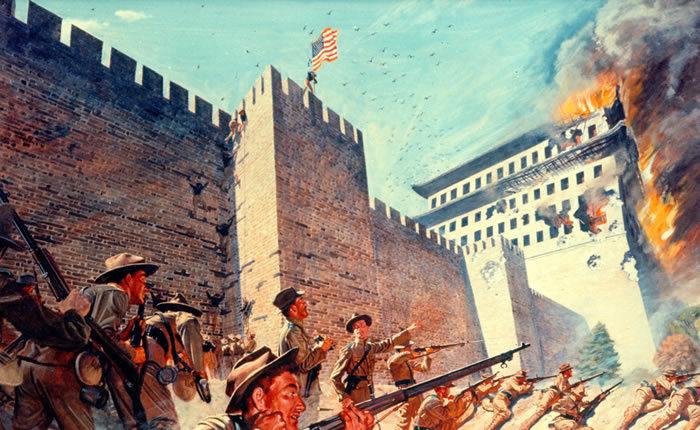
American troops scale the walls of Peking
American troops scale the walls of Peking, Boxer rebellion

The Boxer Rebellion in China was the culmination of the reactionary policies of the dowager empress Cixi (Tz'u-hsi) after she crushed the reform movement of 1898 and imprisoned Emperor Guangxu (Kuang-hsu), who had advocated the thoroughgoing reforms. The defeat of the Boxers by forces of seven Western powers and Japan would bring deeper losses of sovereignty and humiliation to China and totally discredit the Qing (Ch'ing) dynasty.

The Boxer movement was rooted in half a century of Western victories over China and the unequal treaties they had imposed on the Chinese, resulting in deep popular resentment among all segments of the people. Many Chinese resented the activities of Western Christian missionaries who had been free to build churches and proselytize throughout the country and were not subject to Chinese laws.

The expansion of Western trade in China and the low tariff that they imposed made Chinese-produced goods noncompetitive against Western imports, damaging the economy. Shandong (Shantung) province was particularly hard hit by economic hardships, the result of frequent flooding of the Yellow River beginning in the 1880s.


Local frustration reached a high point in 1898 due to two events: a particularly bad flooding of the Yellow River and Germany's establishment of a sphere of influence in Shandong. A Chinese secret society called the Yihe chuan (I-ho chuan), or the "Righteous and Harmonious Fists," capitalized on the popular discontent.

It was an offshoot of the White Lotus Society and the Eight-Trigram Sect, which had risen in revolt against the Qing dynasty in the late 18th century. Their members claimed magical powers through the practice of shadow boxing, charms, and magical arts. Westerners called its members Boxers because they practised martial arts.

Boxer soldiers

The Boxers were mostly poor unemployed farmers and were initially noted for being both antiforeign and antidynastic. However, they were soon co-opted by Cixi and the powerful reactionary Manchu nobles who surrounded her, who hoped to use them to consolidate their power. They skillfully manipulated the Boxers to support the Qing and whip up xenophobia among the people.

The Boxers were initially most active in Shandong. However, acting governor Yuan Shikai (Yuan Shih-k'ai) was no fool and knew that their martial arts were no match for firearms. He defied Cixi's order to afford them protection, suppressing them and driving them out of the province.

They found a new home in Zhili and Shanxi (Shansi) provinces and were welcomed by Cixi into Beijing (Peking), where they were organized into a militia and "proved" their invulnerability to bullets by a demonstration before her with blanks. Then followed a reign of terror by the Boxers, killing Westerners, Chinese converts to Christianity, and anyone who opposed them. Cixi executed a number of officials opposed to the Boxers in the capital, thereby silencing opposition.

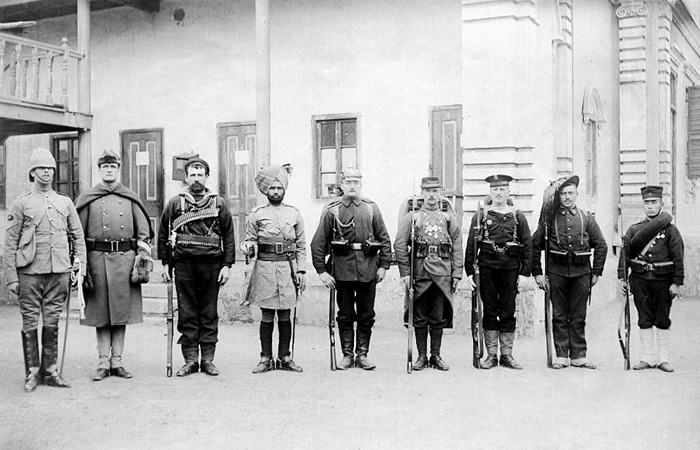
Troops of the Eight-Nation Alliance in 1900

On June 21, 1900, Cixi issued an edict declaring war against all Western nations, ordered all Chinese diplomats stationed in the West to return home, and ordered provincial governors to round up all foreigners.

She also ordered the cutting of telegraphic links between China and the outside world. Several Western diplomats were killed in the capital city, and a Boxer force besieged the Western diplomatic quarters.

Fortunately, governors in the south and eastern provinces, including the senior statesman Li Hongzhang (Li Hungchang) and Yuan Shikai, among others, jointly declared the court's declaration of war illegitimate and their intention to suppress the Boxers and protect the foreigners in their territories. Likewise, Chinese diplomats stationed in the West declared Cixi's moves illegitimate since the rightful ruler, Emperor Guangxu, was held prisoner by her.

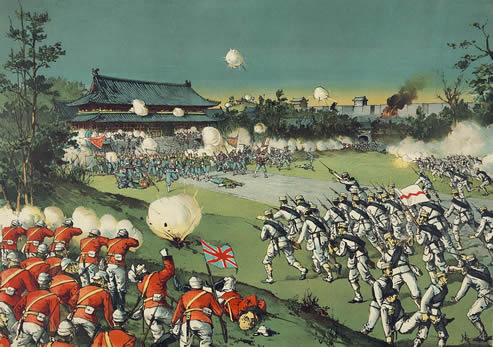
A relief force consisting of units of Great Britain, France, Germany, Russia, Austria-Hungary, Italy, the United States, and Japan was organized and captured Beijing on August 14, lifting the siege of the diplomatic quarters because with no artillery pieces, the Boxers had been unable to capture the sandbagged buildings that held the diplomats, Western missionaries, and Chinese Christians inside.

The Fall of the Peking Castle

Meanwhile, Cixi, her nephew the captive emperor, and her supporters had fled Beijing disguised as farmers. The city and environs were subjected to severe destruction and looting by the conquering soldiers.

Diplomats of the eight powers then negotiated terms among themselves to dictate to China. The Boxer Protocol (1900) had 12 clauses: official apologies, punishment of the guilty, suppression of antiforeign organizations, no civil service examinations to be held in provinces that supported Boxer activities, the demolition of Chinese forts at Taku (that controlled entry to Beijing by sea), no import of arms by China for two years, the Western powers to be able to garrison troops at designated points in northern China and to fortify their diplomatic quarters, the abolition of the Zongli

Yamen (Tsungli Yamen) that had conducted Chinese foreign affairs since 1862 (to be supplanted by a new ministry of foreign affairs), and an indemnity of 450 million gold taels (1 tael=1 1/3 ounces) to be paid over 40 years. China was not represented at the negotiations and was not permitted to change a word in the protocol.

Japanese executing Boxers as Indian and Japanese troops look on

Li Hongzhang was appointed head of the delegation to offer apologies to the Western powers—he died soon after completing the task. Allied soldiers evacuated Beijing in September 1901. Cixi returned to Beijing in 1902 and issued a proclamation blaming Guangxu for all that had happened.

The Boxer Rebellion was propelled by popular anger against Western imperialism that was manipulated by an ignorant and reactionary court headed by Cixi. Both the Boxers and Western troops caused terrible suffering among innocent people, the inevitable collapse of the Boxer Rebellion plunged China's existence into jeopardy, and ultimately it spelled the death knell of the Qing dynasty.

Claire Lee Chennault

Claire Lee Chennault

Claire Lee Chennault grew up in rural northeastern Louisiana. He served as a fighter pilot of the U.S. Army Air Corps during World War I. After the war he served as an instructor in the army air service, organized and led an air corps acrobatic team called Three Men on a Flying Trapeze, and worked on perfecting air combat tactics. Health problems led to his retirement from the military in April 1937.

On July 7, 1937, Japan attacked China, beginning World War II in Asia, whereupon Italy, later Japan's partner in the Axis, withdrew its air force mission from China. Chinese leader Chiang Kai-shek contacted Chennault and his two partners in Three Men on a Flying Trapeze to help China develop an air defense system; all three accepted.

Chennault arrived in China in 1938 and was commissioned as a major in the Chinese air force. He developed a close working relationship with Madame Chiang Kai-shek (Mei-ling Soong Chiang), commander of the Chinese air force.


Chennault first developed an effective air raid warning system by training Chinese spotters in Japanese-occupied areas, using radios to report the takeoff and direction of Japanese planes on bombing raids. In October 1940 Chiang sent Chennault to the United States to procure planes and enlist American combat pilots and a support staff to defend China. He secured 100 P-40 Tomahawks originally intended for Great Britain (which received instead a newer model of the plane), funded with $25 million through the Lend-Lease Act passed by Congress.

President Franklin D. Roosevelt then signed an executive order that allowed U.S. active and reserve military personnel to resign from their commissions and join the American Volunteer Group (AVG) to serve in China. Over 300 people—pilots, mechanics, and support personnel—signed up, including four women (two nurses and two office workers).

They were given fictitious job descriptions and headed for Toungoo, Burma. There Chennault trained them in tactics of aerial combat, with special attention to the planes and techniques used by the Japanese air force. The AVG men liked the shark mouth painted on British Tomahawk planes in Egypt but changed the logo to the "Flying Tiger."

The Flying Tigers
The Flying Tigers

The final design was created by Walt Disney. Their flight jackets had a patch called the "blood chit" that read in Chinese: "I am an aviator fighting for China against the Japanese. Please take me to the nearest communication agency." It proved a lifesaver for pilots shot down in Japanese-occupied China.

The AVG's first action took place on December 20, 1941, against 10 Japanese bombers flying out of Hanoi for Kunming in China. Only one returned. Between that day and July 4, 1942, when it was disbanded, the AVG fought and won 50 actions despite overwhelming negative odds.

For example, on February 25, 1942, the 166 Japanese planes attacking Rangoon, Burma, met nine Flying Tigers, who downed 23 planes and made another 10 probable kills, losing only one plane themselves. Chennault had the backing of thousands of Chinese workers, who repaired the runways after Japanese raids, and a large network of scouts, who kept him informed of Japanese movements.


The Chinese government paid the AVG salaries and bonuses for downed Japanese planes. In all, the AVG had 299 confirmed kills and damaged 153 planes so badly that they probably could not fly again, in addition to many destroyed on the ground.

It also destroyed thousands of tons of Japanese supplies and many trucks. A total of 29 AVG men would become aces for recording five or more enemy kills. It lost 12 planes in combat, 61 planes on the ground, 13 men in action, and 10 in operational accidents.

Although the U.S. government could not honor the AVG members, the Chinese government decorated many for heroism, as did the British government for their actions over Rangoon. Many of its men joined the regular U.S. Army Air Corps after the AVG was disbanded. Chennault also continued to serve in China, but for the U.S. armed forces.

The AVG lasted for less than two years and saw action for nine months. Chennault's skill, temperament, and courage were essential for molding its members into a great fighting unit that inflicted heavy damage on the Japanese, boosted Chinese morale, and contributed to Allied victory in World War II.

Following the war Chennault remained in China to assist the Nationalist government against the Communists. During that time he organized an airline called Civil Air Transport (CAT), which would later become a major resource for the U.S. Central Intelligence Agency in South Asia. Chennault died on July 27, 1958, in New Orleans, Louisiana.

Chiang Kai-shek

Chiang Kai-shek
Chiang Kai-shek

Chiang's proper name was Chung-cheng, but he is better known by his courtesy name, Kai-shek. The son of gentry parents from Fenghua in Zhejiang (Chekiang) Province, Chiang was raised by a widowed mother, graduated from the first class of Paoting Military Academy, and then studied in a Japanese military school, where he joined Dr. Sun Yat-sen's revolutionary movement, later called the Kuomintang (KMT, or Nationalist Party [Guomindang]), in 1911.

It became his lifelong cause. He fought in the wars that overthrew the Manchu Qing (Ch'ing) dynasty in 1911 and with Sun out of power in 1912, became a businessman in Shanghai.

In 1922 Chiang answered Sun's call in Canton. Sun sent him to the Soviet Union in 1923, where he spent three months studying Red Army techniques and in talks with Leon Trotsky (father of the Soviet Red Army). This trip made him deeply suspicious of Soviet intentions in China.


Back in China he founded the Whampoa Military Academy, which trained officers in Sun's Three People's Principles and in modern military techniques. In 1926 Chiang led the Northern Expedition to unite China under the Kuomintang.

His rapid victories led to the capture of southern China and the Yangzi (Yangtze) River valley by 1927, whereupon he broke with the Soviet Union, expelled its advisers, and purged the KMT of its left-wing elements, led by Wang Jingwei, and their Chinese Communist Party (CCP) allies. By 1928 Chiang's forces had captured Beijing (Peking). Defeated warlords and those facing defeat promised to obey the KMT, and China was unified, at least nominally.

Chiang's wife Song Meiling, and Gen. Joseph "Vinegar Joe" Stilwell in a light moment at Maymyo, Burma, 19 Apr 1942.
Chiang's wife Song Meiling, and Gen. Joseph Stilwell.

The KMT-led National Government established its capital at Nanjing (Nanking), where for the next decade Chiang led China's first modern government, whose major nation-building projects included roads and railroads, modern schools, new law codes that made women equal, industries, and the military.

Chiang and his government were challenged by three enemies: the remaining warlords and his rival generals in the KMT, whom he partly succeeded in taming; the CCP, which established a Chinese Soviet Republic in Jiangxi (Kiangsi) province in southern China (Chiang defeated but did not eliminate them in the encirclement campaigns and the Long March); and Japan, which sought to seize Chinese territories beginning with the Manchurian incident in 1931 and culminating in the Marco Polo Bridge incident in 1937, which led to eight years of war that became part of World War II.


Chiang led China in an exhausting war in which Japan occupied the coast but could not conquer China. China's role in World War II led to its recognition as a leading Allied power. It was a founding member of the United Nations and a permanent member of the Security Council.

However, victory came at a heavy price. China's economy was ruined, tens of millions of refugees awaited resettlement, and Chiang's troops were exhausted. War vastly expanded the CCP's power, from 30,000 troops in 1937 to 3 million in 1945.

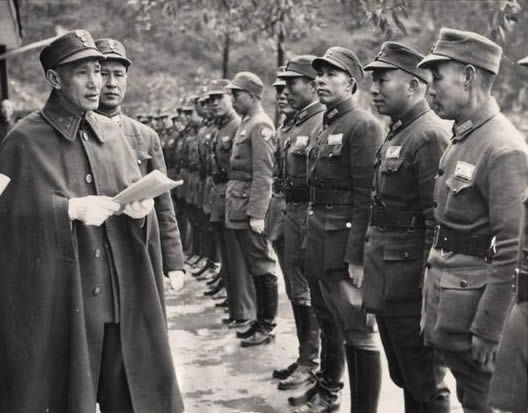
Chiang Kai-Shek inspecting Chinese troops at new infantry training center in Kwangsi Province
Chiang Kai-Shek inspecting Chinese troops

The CCP refused to participate in a constitutional process initiated by the KMT, and civil war broke out between the KMT and CCP forces in 1946. Chiang resigned as president of China in 1948, and all China came under CCP control in 1949. Remnant KMT forces rallied behind Chiang on Taiwan in 1949, and Chiang resumed his presidency in 1950 and continued to serve until he died in 1975.

Chiang's government undertook land reforms and successful economic measures on Taiwan with U.S. economic and military aid. By 1975 it was well on its way to the success that made it one of the "Four Tigers" of Asia.

Statue of Chiang Kai-shek in Yangming Park, Yangmingshan National Park, Taipei, Taiwan
Statue of Chiang Kai-shek in Yangming Park, Taipei, Taiwan