Showing posts with label german. Show all posts

D-day

D-day

Although it is a general military term, D-day has become synonymous with the Allied invasion of Normandy, France—code-named "Operation Overlord"— on June 6, 1944, during World War II. Following the German invasion of the Soviet Union in 1941, Soviet premier Joseph Stalin called on the Allies to open a second front in western Europe.

By May 1943 such a plan had become the Allies' number one priority. At a meeting held in Quebec, Canada, Lieutenant General Frederick Morgan, chief of staff to the Supreme Allied Command, presented a preliminary plan to the Allied leadership.

With input from Lord Louis Mountbatten, chief of the British War Department's Combined Operations Division, Field Marshal Bernard L. Montgomery, and numerous others the invasion plan began to take shape; by D-day close to 30,000 civilian and military personnel had worked on the plan in some capacity.


Officially, "Overlord" was the overall designation for the Allied offensive that would run from June to August 1944; the naval and beach assault operations on the day of June 6 were code-named "Operation Neptune," with various related operations, such as airborne drops, given their own code names.

To gain a foothold on mainland Europe and liberate it from Nazi occupation, "Neptune" involved a strategy of coordinated attack from the air, sea, and land that culminated in an amphibious assault by Allied forces—composed of U.S., British, and Canadian troops—upon the German-held beaches of Normandy in northern France.

In December 1943 American general Dwight D. Eisenhower was chosen as supreme Allied commander, with three British commanders in charge, respectively, of air, sea, and land forces: Air Chief Marshal Sir Trafford LeighMallory, Admiral Sir Bertram H. Ramsay, and Field Marshal Montgomery.

D-Day naval bombardments map

Likewise, Air Chief Marshal Sir Arthur Tedder, the deputy supreme Allied commander, and General Walter Bedell Smith, Eisenhower's chief of staff, supervised the massive logistical task of coordinating the men and materials needed for the invasion.

Before settling on Normandy, Allied commanders had considered the Pas de Calais, the narrowest point in the English Channel between England and France. However, Mountbatten felt that although Normandy was farther away, it offered an ideal location for two main reasons: long, sheltered beaches that would be less defensible, theoretically, than Calais and two large ports vital to the invasion fleet, Cherbourg and Le Havre, which could be captured by land.

As commander of all ground forces, Montgomery pushed for five beachheads, which Eisenhower endorsed—"Utah" and "Omaha," assigned to the American-led Western Task Force, and "Gold," "Juno," and "Sword," assigned to the Britishled Eastern Task Force.

army landing

Both task forces comprised the 21st Army Group, consisting of the British Second Army, commanded by Lieutenant General Sir Miles Dempsey; the Canadian First Army, commanded by General Henry D. G. Crerar; and the U.S. First Army, commanded by Lieutenant General Omar N. Bradley.

For the Germans, Field Marshal Gerd von Rundstedt commanded all forces in western Europe (Oberbefehlshaber West), consisting of Army Groups (Heeresgruppen) B and G; Field Marshal Erwin Rommel commanded Group B, which was given the task of defending the channel coast. Because of the fight with the Soviet Union that reduced troop strength in the west, Adolf Hitler charged Rommel with shoring up gaps in the coastal defenses that exposed Germany's western flank to invasion.

Coined the "Atlantic Wall"—consisting of concrete bunkers, gun emplacements, and varied obstacles on land and in the sea that extended along the English Channel, the Atlantic, and the French Mediterranean—by May 1944 the Germans had poured close to 18 million cubic meters of concrete and placed over half a million obstacles. Rundstedt and Rommel disagreed, however, on how to defend against an Allied threat.


Rundstedt pushed for a central reserve farther inland that could counterattack once Allied intentions were known; Rommel, on the other hand, advocated confrontation at the point of invasion, with the strongest units readied to "push them back into the sea." With neither willing to concede, a plan developed that encompassed both ideas—which would prove ineffective in the end.

The Calais Deception

Despite the Allies' choice of Normandy, Calais still played an integral part in their plan. Many in the German High Command, most notably Hitler himself, believed Calais to be the genuine target of any Allied offensive against the mainland.

Through a deception operation known as Operation Fortitude, the Allies broadcast fake radio traffic and invented nonexistent armies that pointed toward an invasion at Calais. Hitler and the High Command, headed by Field Marshal Wilhelm Keitel, believed that any actions by the Allies against the mainland would simply be a diversionary tactic to draw away from the real target of Calais.

Consequently, the Germans concentrated a majority of their best reserves, including the powerful 15th Army (Armee Oberkommando), in the Pas de Calais region, with the weaker 7th Army stationed at Normandy—a maneuver that would prove costly when D-day arrived.

Originally planned for May 1, 1944, the invasion date was set for dawn on one of three days—June 4, 5, or 6. Imperative that a combination of moonlight and high tide coincide in order to aid, respectively, the airborne and beach landings, Allied commanders chose June 5. However, unfavorable weather conditions caused Eisenhower to delay for 24 hours. The next optimal window of opportunity not until late July, Eisenhower made the decision to proceed with the invasion.

Just after midnight on June 6, the American 82nd and 101st and British 6th Airborne Divisions landed by parachute and glider on the Cotentin Peninsula behind German lines in support of the amphibious landings only a few hours away. Throughout the previous month the Allies had conducted a bombing campaign against key areas of northern France to destroy German communications.

In addition, French resistance, having received word of the impending invasion, sabotaged communication lines and railroads to delay German mobilization even more. The three airborne units, tasked with the further disruption of German capabilities, were to secure the flanks of the beaches, capture strategic bridges and causeways for Allied use, and destroy other key bridges that the German counterattack could utilize.

D-day casualties
D-day casualties

For the British 6th, assigned to capture the bridges spanning the Orne River and Caen Canal and protect the left flank of Sword Beach, mission execution was near flawless. Commanded by General Richard Gale, the division quickly completed its objectives within hours of landing in France and with very little mishap.

They had only to hold their position to await relief from the main attack force and keep German reinforcements—specifically the armored tank units— from advancing on the beaches. Unfortunately, the same could not be said for American paratroopers.

Due to poor visibility, German antiaircraft fire, and inexperienced pilots who had not flown in such conditions, both the 82nd and the 101st found themselves scattered across the peninsula. Nevertheless, per their training, units that failed to reach their designated zone were to carry out the missions assigned to the area in which they found themselves.

As a result, mixed units were able to assemble, organize, and achieve objectives on a limited scale. Ironically, German commanders became confused as to the Allies' intended target due to this situation, thus failing further to mobilize against the impending invasion.

As the airborne units carried out their missions, an Allied armada—the largest ever in history, which included close to 1,000 warships and 4,000 transport ships—made its way from assembly areas in southern England toward the Normandy coast. Having cancelled coastal patrols, the Germans were unaware of the Allied advance across the English Channel.

Nurses arrives in normandy

Around 5:00 a.m. a sustained Allied naval bombardment and assaults by bomber aircraft commenced against the German defenses on Normandy. The seaborne troops then began their approach to the five beaches by transport ships. The first ashore were elements of the U.S. 4th Division, landing at approximately 6:30 a.m. on Utah under intense German fire.

South of their target zone they faced lighter resistance than anticipated, thus minimizing expected casualties, and advanced rapidly up the beach to gain their objective. Only a few minutes later elements of the U.S. 1st and 29th Divisions landed at Omaha, where intact obstacles and fierce opposition bogged down subsequent waves of soldiers and equipment.

The congestion made the Americans easy targets for German gunners, resulting in the worst casualty rates of the entire invasion force—estimated at close to 95 percent for the first wave alone. Pinned by enemy positions atop the high bluffs that dominated the beach, many units suffered losses close to 60 percent and higher, which threatened the assault's success.

On the three other beaches the results were just as mixed. Landing around 7:30 a.m. on, respectively, Sword and Juno, the British 3rd Division, which also included French commandos, and the Canadian 3rd Division met typical conditions—obstacles that hindered their progress and strong opposition as well as the capacity to advance rapidly onward.


Thanks to continued naval bombardments that suppressed German defensive fire, both divisions were able to move inland by early afternoon. However, the British 50th Division, landing on Gold only a few minutes before, encountered an almost identical situation to what the Americans found on Omaha. Despite continual deployment of troops, the division could not secure the beach until after nightfall.

By the end of the day, close to 150,000 Allied troops had landed in France. In spite of heavy losses, although lower than expected, and the day's slow advance, which did not push inland as far as planned, the invasion was a dramatic success for the Allies.

El Alamein

British defence in El Alamein

El Alamein is railway station west of the Egyptian port of Alexandria where a series of three battles were fought in 1942. The result was the end of German and Italian aspirations of conquering Egypt and advancing into the Middle East. El Alamein was one of the most decisive battles of World War II not only because of its strategic results but also because of how it altered perceptions about who could win the war.

In 1940 Libya was an Italian colony that bordered on Egypt, where British troops were stationed in force. When the Italians joined the war in June 1940 on Germany's side, they expected that they would be able to attack France and gain some quick and easy concessions. They did not expect that the British, outnumbered by the Italians, would attack.

Yet under the direction of Generals O'Connor and Wavell, that is exactly what they did. The British captured the port city of Benghazi. They were well on their way toward capturing all of Libya when they were counterattacked by the Germans, reinforcing the Italians.


The Germans took the city of Benghazi back from the British and then advanced to Egypt and the Suez Canal. The German commander Erwin Rommel next attacked the city of Tobruk, was in turn attacked by the British, and was forced to retreat. The British managed to force him back deep into Libya.

In the next year Rommel counterattacked, retaking Benghazi and capturing Tobruk. From there he again advanced and crossed the border into Egypt. He was stopped at the First Battle of El Alamein in July 1942. Both sides waited for a time.

The British solidified their positions, while Rommel gathered his increasingly small amount of supplies, including fuel for his vehicles. In the first week of September, Rommel felt he had to attack and so launched an assault on the British positions at a place called Alam Halfa in what became known as the Second Battle of El Alamein.

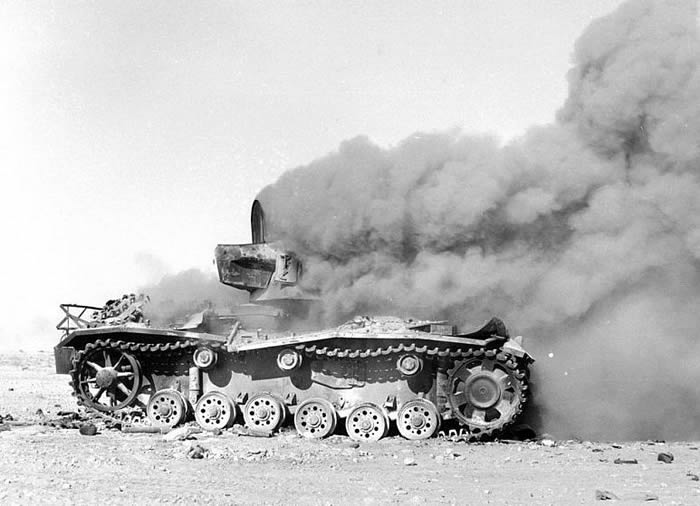
German panzer destroyed in El Alamein battle field
German panzer destroyed

Repulsed by the British, Rommel now began efforts to fortify his positions, creating obstacles through the use of minefields. He had no realistic expectation of attacking again and so had to remain in place. Although he had advanced so far into Egypt, the situation now favored the British.

The troops under the British commander Montgomery outnumbered Rommel's nearly two to one and had at least twice as many tanks. In all aspects the British supply situation was much better. Rommel had so little fuel that his ability to move was severely limited. At the same time, the British gasoline was more plentiful than water.

That logistical superiority was to translate into immense tactical superiority on the night of October 23, 1942. That night the British opened with a massive artillery barrage using over 600 guns.


This extensive artillery preparation lasted several hours and moved its focal point up and down the German line. Then it moved forward to allow the combat engineers with supporting tanks to disarm the extensive minefields that formed the backbone of Rommel's defenses.

The process of attacking by the 8th British Army was slow and methodical and would concentrate first on one part of the German line and then on another. Montgomery referred to this process as "crumbling" the enemy's defenses.

The Germans counterattacked but failed in their attempt to drive the British back. Finally, on November 2 the British broke through the last belt of minefields, and the attack could begin. By November 4 Rommel decided to retreat to the west.

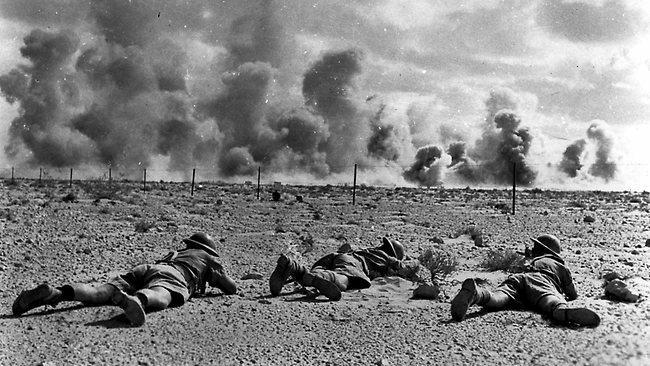
Australian troops crawling along the ground during the Battle of El Alamein in 1942
Australian troops crawling along the ground

From the west, in French North Africa, the Americans landed an army of over 400,000 men, who advanced eastward. Caught between the British and the Americans, Rommel's army surrendered in Tunisia in May 1943. The war in Africa was over.

At El Alamein Rommel was at his farthest point from his base of supplies. He had one route that followed the coastline; everything had to come to him that way from the Italians in Libya. Their bases were supplied by ship from Italy. This supply route was under constant attack by British submarines and aircraft.

Italian and German ships were sunk, and much of what was supposed to go to Rommel never reached him. Supply superiority translated into tangible benefits: more tanks and cannon as well as massive air superiority. That also translated into intangibles such as better morale helped by ample stores of food and other supplies.

If the British had lost at El Alamein, they could have lost all of Egypt, which would have been catastrophic. The Germans had hoped to link up with their soldiers in Russia by this route. The Germans could have captured the Suez Canal and controlled the Mediterranean. A push further would have brought them into Palestine.

There was no oil there, but a pipeline from Iraq built in the 1930s would have given them access to it. Considering that the government in Iraq was pro-Nazi, that would have solved Germany's oil problems. Further, the loss would have damaged British prestige and credibility.

Dietrich Bonhoeffer

Dietrich Bonhoeffer
Dietrich Bonhoeffer

Dietrich Bonhoeffer was a German pastor and brilliant theologian who was made famous by his role in the German resistance movement. He was executed in April 1945 for his involvement in plots to overthrow Adolf Hitler.

Bonhoeffer and his twin sister, Sabine, were born on February 4, 1906, in Breslau, Germany (now Wroclaw, Poland). His father, Karl Bonhoeffer, was a distinguished psychiatrist, and his mother, Paula, presided over the early education of her eight children with the aid of a governess, entering her children for state examinations at an early age.

In 1912 the Bonhoeffers moved to Berlin, where Dietrich's father took a post as a professor of psychiatry. By age 14 Dietrich Bonhoeffer had already decided to pursue theology. His family was not particularly religious, attending church only occasionally, but respected his decision even at a relatively young age.


In 1923 at age 17, Bonhoeffer entered the University of Tübingen. In 1924 he switched to the University of Berlin, a center for theology made famous by one of its founders, Friedrich Schleiermacher. The theology faculty was headed by Adolf von Harnack, an eminent theologian, and Reinhold Seeberg, a well-known systematic theology professor and author. Bonhoeffer stood out as a brilliant, studious, and somewhat independent thinker.

It was during this period that Bonhoeffer began to read and be influenced by the works of the NeoOrthodox movement, a reaction to the liberal theology of Schleiermacher and von Harnack made famous by Karl Barth. Bonhoeffer began work on his doctoral thesis in mid-1926 under Seeberg, finishing in December 1927 at age 21 with a rarely awarded summa cum laude.

Assigned to work for a year as an assistant pastor in a Lutheran church in Barcelona, Spain, Bonhoeffer plunged into congregational life. Always interested in children, Bonhoeffer quickly organized a Sunday school program aimed at boys, who responded well to his leadership.

In 1930–31 Bonhoeffer did postgraduate study in New York at the Union Theological Seminary. Returning to Berlin, he took up his pastoral duties but continued his association with the university. By this time he had published two books (Sanctorum Communio and Act and Being).

In 1931 Bonhoeffer attended an ecumenical conference in Cambridge, England. This conference proved to be the start of his leadership role in the ecumenical movement as well as a wartime cover for many of his activities. During this period, Bonhoeffer's own faith grew more intensely personal rather than simply academic.

In 1933 Adolf Hitler came to power and quickly moved to control the churches. After spending several months in England in late 1933, where he was able to inform British Christians about the increasingly severe plight of Christians in Germany, Bonhoeffer returned to Berlin.
During 1934 the regional churches that were still relatively free from government influence formed what was called the Confessing Church. This church body decided to form unofficial seminaries separate from the theological schools at the government-controlled universities. Bonhoeffer was asked to run a seminary consisting of 23 seminarians in the country town of Finkewalde.

It was during this time that Bonhoeffer wrote his best-known work, The Cost of Discipleship, which was based on some of his evening lectures to the seminarians. In the context of Germany with its unquestioning obedience to the führer, Adolf Hitler, Bonhoeffer focused on what true obedience as a Christian meant. He would eventually prove such obedience with his own life.

In 1939, in part to avoid a call-up into the military, Bonhoeffer went to England for several months. During that time he met with church and ecumenical authorities trying to persuade them to support the Confessing Church on an official basis.

In the United States Bonhoeffer was offered a position as pastor to the German refugees in New York. Accepting it would have meant he could never return to Nazi Germany, then on the verge of war. After much discussion and prayer he chose to return to Germany to share in the fate of his country.

Bonhoeffer's brother-in-law, Hans von Dohnanyi, was already deeply involved in the resistance movement, which at the time was trying to persuade influential generals to arrest Hitler. Hitler's early successes in the war precluded this strategy.

In 1940 Bonhoeffer began working for the Abwehr, the German intelligence service headed by Admiral Canaris ostensibly to gather information for the Germans from his international church contacts. This cover provided Bonhoeffer with the freedom to travel internationally as well as avoid a military call-up but at the same time drew him deeper into the circle of resistance, which included Admiral Canaris himself.

In 1941 and 1942, well aware of the conspiracy to overthrow Hitler, which involved several German generals, Bonhoeffer traveled several times to Switzerland, Norway, and Sweden looking for ways to communicate via church channels to officials in England and elsewhere the necessity for a speedy recognition of the new government that would result from Hitler's overthrow.

In March 1943 Dohnanyi was involved in a failed plot to blow up Hitler during one of his inspection tours. The Gestapo investigations of the resistance were drawing their nets tighter around Canaris and his associates, and on April 5, 1943, Dohnanyi, Bonhoeffer, and several others were arrested on suspicion of conspiracy and put in prison in Berlin.

Bonhoeffer had carefully prepared for this moment and was able to evade the charges against him successfully, although he was never released from prison. His case never came to trial, and in 1944 it increasingly looked like Bonhoeffer would be released. During his time in prison Bonhoeffer secretly worked on his book Ethics, which was published posthumously.

On July 20, 1944, there was another assassination attempt on Hitler by the conspirator von Stauffenberg. The resulting investigation uncovered incriminating evidence against Canaris and Dohnanyi and indirectly against Bonhoeffer. This judgment sealed the fate of all the conspirators. They were moved to a concentration camp, where they were hanged on the personal orders of Hitler on April 9, 1945.

Adolf Hitler

Adolf Hitler
Adolf Hitler

Adolf Hitler, the dictator of Germany, proponent of Nazism, and perpetrator of the Holocaust, was born on April 20, 1889, in the Austrian town of Braunau near the German border. His father, Alois, was a customs official, and his mother, Klara, was a gentlewoman. Hitler did not finish his secondary education and moved to Vienna at the age of 18 to study art and architecture.

He was unsuccessful in getting admission and stayed in Vienna until 1913, doing menial jobs. Hitler developed a rabid nationalism and simultaneously showed deep anti-Semitism. He was influenced by anti-Jew writer Lanz von Liebenfels (1874–1954).

The right-wing Austrian politician and mayor of Vienna Karl Lueger (1844–1910), along with Georg Ritter von Schönerer (1842–1921), an advocate of pan-Germanism, also shaped Hitler's violent hatred of the Jews.


He enlisted in the German army during World War I. Hitler returned to Munich in 1919 with five medals and the prestigious German Iron Cross (twice) for his bold service as dispatch runner. The war had rescued him from the frustration of civilian life and inculcated in his mind a strong like of discipline and authoritarianism.

He had also developed a deep hatred of left-wing politics, and it was no coincidence that his anti-Semitism developed along with his political beliefs, as many of the advocates of socialism and communism were Jews.

The army employed Hitler as a political officer, and he freely gave vent to his feelings in the charged atmosphere following the humiliating Versailles Treaty of June 28, 1919. The treaty signed by the German politicians was a peace dictated by others, and German humiliation was complete.

Hitler was to report the activities of the Deutsche Arbeiterpartei (DAP, German Workers' Party), and he soon found that the party ideals of extreme nationalism and anti-Semitism were in line with his own beliefs.

With his excellent skill of delivery, Hitler impressed the members and joined the DAP. Thus, the political career of Hitler began in September 1919. He was soon placed in charge of propaganda and recruited fellow soldiers from the army who had also been disillusioned with the Treaty of Versailles.

Nazi Party

All the blame for Germany's woes was put on the Jews, communists, and inefficient political leadership of the Weimar Republic. Hitler made the symbol of the party the swastika (symbolizing victory for the Aryan race) with a red background (symbolizing the social idea) and enclosed in a white circle (symbolizing the national idea).

Hitler changed the name of the DAP to the National Socialist German Workers' Party (NSDAP, Nationalsozialistische Deutsche Arbeiterpartei), Nazi for short. As chairperson of the party, Hitler was addressed as the führer (leader).

The Weimar Republic received a severe blow in January 1923, when France and Belgium occupied the Ruhr industrial area and brought the German economy to a standstill. Hitler tried to exploit the situation with the Beer Hall Putsch of November in Bavaria, but the coup failed and the führer was imprisoned.

During his period of incarceration, he wrote Mein Kampf (My struggle). The memoir-cum-doctrinal Nazi guide book spelled out an agenda for an expanded Germany inhabited by a pure Aryan race and excluding Jews and other unwanted people.

Hitler was biding his time and realized that he could attain power through the ballot box. The collapse of the New York Stock Market on October 23, 1929, and the consequent worldwide Great Depression affected the German economy.

The unemployment figure rose from 1.30 million to nearly 4 million by the end of 1930. Hitler exploited the deteriorating economic situation. He had assured the top industrialists, by issuing a pamphlet entitled The Road to Resurgence, that the Nazi Party was not against the wealthy.

His promise of suppression of trade unionism and building up of the army was music to the ears of big industrialists. His technique of propaganda and rabble-rousing speeches appealed to the workers. The political elite began to accept him because of his emphasis on legality.

In the 1932 elections Hitler's party was the strongest in Germany, with 40 percent of the votes. The Reich president, Paul von Hindenburg (1847–1934), was persuaded by conservative leaders and Nazi supporters to appoint Hitler chancellor in January 1933.

Nazi political opponents were subdued by mass demonstrations in favor of Hitler and terrorized by the brown-shirted SA, the Sturmabteilung (storm troopers), and the black-uniformed ss, the Schutzstaffel (security echelon).

In March an act that granted dictatorial power to Hitler was passed. After four months all political parties were banned save the Nazi Party, and the common form of greeting became "Heil Hitler" with an outstretched right arm.

A ministry of propaganda was instituted under Joseph Goebbels (1897–1945). On June 30, 1934, Hitler carried out a purge in the Nazi Party by murdering his opponents in the "night of the long knives." With the death of Hindenburg in August, Hitler, with the title of führer, was the supreme leader of Germany.

The legal system was virtually nonexistent, and the Geheime Staatspolizei (the Gestapo, the secret state police), formed by Hermann Göring (1893–1946), threw the anti-Nazis into concentration camps. A rearmament and public housing program were initiated.

The economy revived, and the unemployment figures went down. Germany became 83 percent self-sufficient in agriculture by fixing farm prices and wages, banning the sale of farms of less than 312 acres, and reclaiming uncultivated lands.

Industrial recovery was achieved by the Four-Year Plans of 1933 and 1936. The ministry of economics distributed raw materials and regulated prices, imports, and exports. Hitler's popularity soared, while Germany had been transformed into an authoritarian state.

Hitler struck against the Jews, which culminated in the Nazis' sending them into gas chambers and concentration camps during World War II. The Nuremberg laws of September 1935 denied the Jews citizenship and the right to marry non-Jews.

Hitler's policies led to large-scale Jewish migration to different parts of the world. The November 1938 pogrom against the Jews resulted in massacre, looting of property, the forcing of Jews to wear yellow stars of David so that they could be identified, and resettlement in ghettos.

Hitler posed as a defender of peace and a crusader against Bolshevism. The leadership of Britain and France appeased Hitler because to them Joseph Stalin (1879–1953) was a greater menace. With consummate skill Hitler began to scrap the provisions of the Treaty of Versailles and to follow the policy of Lebensraum in an eastward direction.

Hitler withdrew from the Geneva Disarmament Conference as well as from the League of Nations in October 1933. He denounced the provisions of the Treaty of Versailles and introduced conscription in March 1934.

The next year Germany began expanding its armed forces and its navy in flagrant violation of the military clauses of the Treaty of Versailles. In March 1936, Hitler occupied the demilitarized Rhineland. Italy and Japan, with the same agenda of ultranationalism, militarism, and aggressive foreign policy, became close allies of Germany. The three countries signed pacts for furthering their aims.

The Rome-Berlin Axis was established between Benito Mussolini (1883–1945) and Hitler in October 1936, and the following month Germany signed the Anti-Comintern Pact with Japan, which Italy joined in 1937.

Both Hitler and Mussolini supported General Francisco Franco (1892–1975) in the Spanish civil war against the republicans. Continuing his policy of lebensraum, Hitler turned his attention toward Austria, which was German in tradition and language. There had already been a putsch in 1934 for Anschluss (annexation). In March 1938 the Nazi army marched in and annexed Austria.

The republic of Czechoslovakia, with its minority population of 3.25 million Sudeten Germans, was next on the agenda. Great Britain and France followed a policy of appeasement toward Hitler. They thought wrongly that Hitler would remain satisfied, but it was not so. At the Munich Conference of September 29, 1938, Czechoslovakia was dismembered, and the Sudeten area was handed over to Germany. In March 1939, the country was occupied by Hitler.

Feverish diplomatic activity, signing of alliances, and mobilization of armed forces were undertaken by the European powers. Hitler in his ingenuity and deviousness began to realize his aim. He signed a military alliance, the "Pact of Steel," with Mussolini in May 1939.

Hitler's diplomacy reached its apogee when he signed the nonaggression pact with Russia on August 23, 1939. He could then turn his attention toward Poland, notwithstanding the fact that Great Britain and Poland had signed a treaty of mutual assistance on August 25, 1939.

The free city of Danzig and the Polish Corridor, dividing eastern Prussia from Germany, were seen as an affront to the Germans. World War II began on April 1, 1939, after Nazi Germany's invasion of Poland. Two days afterward Great Britain and France declared war against Germany. Appeasement had been a failure.

For about two years, the juggernaut of Hitler's Wehrmacht (armed forces) incorporated Poland, Norway, Denmark, the Netherlands, and Belgium. The fall of France on June 22, 1940, was another triumph for Hitler.

Flushed with success, Hitler began to commit the blunder of attacking the Soviet Union on June 22, 1941. Four days after the Japanese attack on Pearl Harbor on December 7, 1941 (December 8 in Japan), Hitler declared war on the United States.

The balance tilted in favor of the Allied powers, and the Axis of Germany, Italy, and Japan faced defeats. Hitler had lost battles in Russia and North Africa. He helped Mussolini set up a government after the Allied invasion of Sicily in 1943, but the Allied army reached Rome in June 1944. The Normandy invasion was launched on June 6.

The Red Army of Russia was advancing from the east, and Hitler was ensconced in Berlin. Surrounded by the Soviet troops, Hitler committed suicide in the Führerbunker on April 30, 1945. On May 8 the German forces surrendered unconditionally at Rheims in France. The "thousand years Reich" had lasted for 12 years.

Maginot Line

Maginot Line
Maginot Line

There was never unanimous consensus among military men about the lessons of World War I. When the adversaries of 1914–18 fought again in 1940, the Germans interpreted their experience as one that taught the need for a rapid and forceful offense.

Interpreting that same conflict quite differently, France planned to fight almost purely defensively in the first stages. It would then attack the Germans, who they believed would have worn themselves out assaulting the centerpiece of French strategy, the Maginot line.

Planned in the 1920s and essentially completed by 1935, the Maginot line (named after a French minister of war) was a network of fortifications on the border between Germany, Luxembourg, and Italy. The line was designed and built to serve several purposes.


First, the Maginot line would protect French industry in the Alsace-Lorraine region. Second, a strong defensive line would help the French make the most of their available forces while mobilizing their remaining reserves.

Finally, it was envisioned that the Germans would go directly for the line, allowing the French to hold them off and inflict heavy casualties. The relatively fresh French would then launch an assault of their own and defeat the Germans on their own territory.

The Maginot line was not an uninterrupted line like the trench system of World War I. Instead, it was a network of steel and concrete fortifications facing the Germans to the east and the Italians to the southeast. Each fort (commonly designated as an ouvrage, or work) was an independent structure; in all there were over 100 of these with additional minor fortifications.

maginot line fort diagram

Using guns in a variety of calibers, each fort was within the range of another so they not only could fire on assaulting troops but could also cover other forts in the immediate area. To add further support, there were permanent garrisons of "interval troops," infantry units that would provide support in the areas between forts.

The forts were among the most advanced technical structures of the day. Each had large storage areas for ammunition, facilities for food supplies, command centers, fire control centers, miles of tunnels, small railroads, air-conditioning, electrical power plants, and water supplies. In addition, the guns were mounted in turrets that used a series of complex, highly advanced mechanical devices to change elevation or direction.

The line was strong, it reflected state-of-the-art technologies for the 1930s, and it even made a high degree of military sense. There were, however, drawbacks. Perhaps the most significant of these was that the line did not go all the way to the North Sea.

Maginot line turrets

France did not extend the line for several reasons: the expense, the unsuitability of the terrain, and the appearance that France was abandoning Belgium. In fact, the French believed that while the Maginot line was holding, the newly mobilized French forces would join with the Belgians to contain the German advance.

Together, probably with British assistance, they would then advance through Belgium and eventually invade Germany. At the same time, the French made an assumption that the very northern end of the Maginot line, which stopped near the Ardennes, would be safe, as the Germans would never launch a major offensive through the rough terrain there.

Although war was declared in September 1939, there was no significant action by either side on the western front until May 1940. This period, known as the phony war, allowed the British and the French to mobilize and bring their troops to hold positions without interference by the Germans.

German invasion
German invasion

On the morning of May 10, over 100 German divisions attacked the French, British, Belgians, and Dutch. The main German attack went through the Ardennes forests and mountains in Luxembourg, south of Liege, exactly where the French had assumed it would never take place.

Thus, the German tanks and motorized forces went around the extreme left flank of the Maginot line and straight into France. They bypassed the line and did not attack it directly until after the British evacuation from Dunkirk and the surrender of the French government. The Maginot line forts surrendered only when their mobile interval troops had retreated and they were completely surrounded.

The Germans occupied the Maginot forts but did not maintain them. They used them only briefly when the United States attacked some nearby French cities in 1944 and 1945. After the war the French army reoccupied them and used them. In the years of the cold war, they provided headquarters and communications centers that would have provided significant protection in the case of a nuclear war.

In the years between the world wars, the French were not alone in seeing the usefulness of fortifications. Although they would rely upon a highly mobile and powerful offensive, the Germans maintained two lines, one facing Poland (the East Wall) and one facing France (the West Wall, better known as the Siegfried line, which would be used in 1944 against the United States).

In addition, Czechoslovakia constructed a line of defenses built with French assistance. Finally, Switzerland had built a complex of fortifications. Although not as extensive as the Maginot or German lines, it was well placed, using the mountainous terrain and command of the few lines of communications through the passes.

The Maginot line has become a symbol. On one level it represents a defense that deluded its builders into thinking they need not do anything else but rely upon what seemed to be an impenetrable defense. It has also become a symbol or a shorthand expression for all of the reasons for France's defeat in 1940.

The irony is that had it been used properly, that is, supplemented with an acute understanding of what the enemy might do and not what the French wanted them to do, it might have been a symbol of victory. As designed, the Maginot line worked. It was the rest of France's strategy that failed.

Nazi Party (National Socialist German Workers’ Party)

Nazi Party propaganda poster

The NSDAP (Nationalsozialistische Deutsche Arbeiter partei), typically called the Nazi Party in English, was a political party in Germany from 1920 to 1945. The party was founded in Munich under a slightly different name in early 1919, one of many political organizations formed in the wake of Germany's defeat in World War I. In September 1919 Adolf Hitler joined the party as a spy for German army intelligence.

The party and its ideology of nationalism, authoritarianism, and anti-Semitism appealed to Hitler so much that he quit his job with the army to devote himself full time to the party. Hitler soon discovered that he was a great orator who could draw new membership to the party. He soon became the party chairman.

He changed the party structure from one of elected leadership and collective decision making to that of Fuhrerprinzip—he was the sole leader and dictated party strategy and policy. He saw the Nazi Party as a revolutionary organization and sought to gain control of Germany through the violent overthrow of the Weimar Republic.


Hitler and the Nazi Party believed that the Weimar government was controlled by socialists, Jews, and the "November Criminals" who had forced Germany to surrender at the end of World War I, backstabbing the German soldiers at the front just as they were about to see victory.

Hitler added a focus of national expansion and pushed policies of anti-Semitism while downplaying the socialistic ideas of the party's founders. Racialism gained prominence through the adoption of the swastika and Aryan identity politics. This racial component and the stated goal of helping the Aryan race to achieve its true destiny set Nazism apart from true fascism.

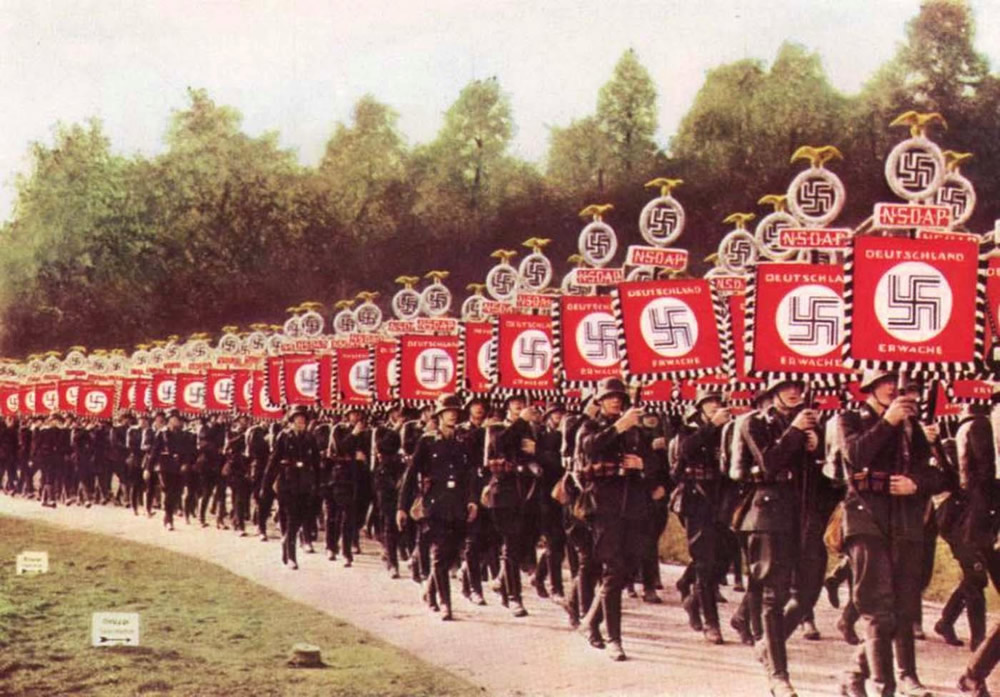
By 1923 party membership had risen to more than 20,000 through campaigning with this new message. To showcase their ideas, the Nazis held rallies once a year at Nuremberg. The rallies advertised Nazi power, unity, and a religious loyalty to Hitler as Germany's savior.

The Nazi masses were paraded before Hitler as oaths of loyalty were taken. During the rallies the Nazis introduced new policies and party doctrine. The Nuremburg race laws were unveiled at the 1935 rally. The 1934 rally was best known for the documentary Triumph of the Will, created by Leni Riefenstahl to showcase the ceremonies. It became one of the bestknown propaganda films of all time.

Nazi party rally at Nuremberg

To enforce Nazi policy on the street and to protect party speakers at political functions, the Sturmabteilung, or SA (also known as the Brown Shirts for the color of their uniforms), was formed. They acted as a party militia and used quasimilitary ranks and organization. Their main visible function was to prevent the disruption of Nazi speeches by communist-based militias.

Later they were used by the party for fundraising, political canvassing, and abuse of party enemies. The SA came into conflict with the German army in 1934 after pushing to become the new national German army. The SA leadership was murdered, and the organization became marginalized thereafter.

In Munich on November 7, 1923, the Nazis launched an attempted coup d'état known as the Beer Hall Putsch. The coup quickly failed, and the ringleaders, including Hitler, were rounded up and sent to prison for short sentences. During his jail stay Hitler wrote a combined autobiography and political manifesto titled Mein Kampf (My struggle).


This book outlined the ideas of a cultural hierarchy with the German Aryans at the top and with Slavs, communists, and Jews at the bottom. The lower people were to be purged from the nation so they could not impede its growth. Hitler also stated that nations grew from military power and civil order. Germany was to grow by expanding to the east into its lebensraum (living space).

The people of Germany were to be led through the principles of Ein Volk, Ein Reich, Ein Führer (one people, one nation, one leader). The relationship between the people and the state was that of loyalty, duty, and honor for the state, while the leader was responsible for protecting the Aryan race against those who sought to destroy it.

While reflecting on politics during his prison sentence, Hitler decided to switch tactics. The Nazi Party would quit attempting to seize power by force. Power would now be achieved through legal means by winning elections.

After his release Hitler's personal bodyguard unit, the SS (Schutzstaffel), or protection squadron, became more important, and notable senior Nazi leaders such as Hess, Himmler, Goebbels, and Göring emerged.

During the new political period the "Heil Hitler" greeting and the Nazi salute were adopted. Electoral success was very small in the 1924 and 1928 elections, in which the Nazi Party only won 3 percent and 2.6 percent of the votes.

The party continued to grow, in part because of the fading of other right-wing political parties and because Hitler assumed leadership of right-wing German politics. The Nazis found support from all areas including small business owners, Protestants, students, rural farmers, and those attracted to paramilitary displays put on by the SA and SS.

Huge gathering at nuremberg

The biggest upsurge in Nazi support came as a direct result of the Great Depression of 1929. The economic hardships caused by the worldwide depression compounded Germany's existing problems and set the stage for Nazi expansion by creating a receptive audience. The German left was divided, and its elements could not work together to counter Nazi propaganda.

The 1930 elections gave the Nazis 18.3 percent of the vote. In the weeks leading up to this election, Germany was blanketed by Nazi campaigning techniques, propaganda delivered by radio and through rapid travel by airplane. The continued economic chaos played into the Nazis' hands and pushed more people into the party. In March 1932, Hitler ran for president, losing to Hindenburg.

During the campaign the SA and SS battled in the streets against left-wing militias; the escalating violence threatened to throw Germany into chaos. Hitler continued to gain support by promising law and order, while at the same time the Nazis were guilty of instigating most of the violence they preached against.

After the elections, neither the Nazi Party nor the communist parties were willing to form a coalition government, so new elections had to be held with much the same result. After much political manipulation, Hindenburg appointed Hitler chancellor in January 1933.

This was seen as a way to solve the electoral deadlock and also as a way to shift blame to the Nazis for Germany's ongoing problems. Hitler did not play into Hindenburg and the cabal's hands.

Shortly after Hitler's appointment, the Reichstag was burned down. Hitler and the Nazis used this opportunity to pass the "Enabling Act," which gave the president dictatorial powers in order to prevent a communist revolution. Hitler used his new powers to gain complete control over the government, police, and communications.

The German people were lulled into complacency by the new Nazi economic practices, which were able to bring Germany out of the Great Depression by ending unemployment, stopping hyperinflation, and increasing the standard of living.

German Synthesis

The period from 1933 to 1939 saw the gradual synthesis of the German state and the Nazi Party. The 1935 Nuremburg laws stripped Jews of civil rights, citizenship, and economic rights and banned their marriage to non-Jews.

In 1938 active pogroms began with the infamous Kristallnacht, which resulted in a number of Jewish murders and involved the destruction of stores, homes, and synagogues; it ended with the deportation of 30,000 Jews to the first concentration camps.

During the war years the party and the state became fused, and Nazism gradually transformed into loyalty to Adolf Hitler. With Hitler's death in April 1945, there was little will to keep the party alive. The party was outlawed after the war, and its trappings were removed from society as part of the Allied occupation.