Ethiopia (Abyssinia) and Italian Aggression

Ethiopia (Abyssinia) and Italian Aggression

In October 1935 Italian armies invaded Abyssinia (Ethiopia), beginning an eight-month war and a sixyear occupation. Starting purely as an Italian colonial venture to expand Italy's control as well as to impress European nations, it came to have a significance all out of proportion to its original objectives.

Italy, as a unified nation, did not come into existence until the Risorgimento of 1870. For that reason, it was very late in developing an overseas empire; most of the colonial pickings had been taken by France and Britain.

Italy had managed in the closing years of the 19th century to establish itself in eastern Africa (Eritrea), although a sound beating by the Abyssinians in 1896 at the Battle of Adowa stopped their progress there. Although Adowa was to be the most severe defeat ever suffered by Europeans in Africa, Italy managed to not only keep its Eritrean possessions but gain a bit more as well.


In 1908 Somalia was declared to be an Italian colony, and the border between Somalia and Ethiopia was agreed on. Additionally, in 1911–12 Italy had managed to seize the Ottoman possessions in Libya. None of this, however, managed to satisfy a nation that as part of its mythic past looked back on the Roman Empire.

Compounding that sense of unfulfilled entitlement, Italy, although an ally in World War I, had not gained the territory it believed was its due. The sense of injury and historic destiny was given an added impetus in the 1920s and 1930s with the rise of the Fascists.

In the interim several events occurred. Although Abyssinia was an independent nation, it was not altogether considered to be the equal of other nations; when it applied for membership in the League of Nations, there were several delegates who were opposed to its entry.

Italian soldiers marching to the Italo-Ethiopian border.

At first Italy opposed Abyssinia's application but then supported it. Abyssinia became a full member of the league in 1923. That fact would have later consequences, as membership meant that Italy could not attack Abyssinia without the threat of action of the entire league.

Italy and Abyssinia signed a treaty of friendship in 1928, but the Italians would maintain a very strong military presence on their borders and on occasion send military detachments across the borders to see how far they could push without starting a war.

By 1932 Benito Mussolini was committed to an eventual war of conquest in the area, and military planning began at about this time. Finally, in 1934 the Italians engineered a border incident that would eventually become the official cause of the war, which would start in October 1935.


The extent of military planning and the allocation of Italy's resources for this war would become a major effort. While in retrospect the campaign was one of tanks, aircraft, and machine guns against a primitively armed native population, there was no assumption of an easy military victory. Adowa, less than 40 years before, had been a serious and sobering defeat.

Even new weapons, as the British, Spanish, and French had learned, did not guarantee victory in colonial wars. The Abyssinians, with their population of an estimated 12 million living in a rugged and wide-ranging homeland, could not be counted on to surrender at the first sight of an Italian tank or airplane.

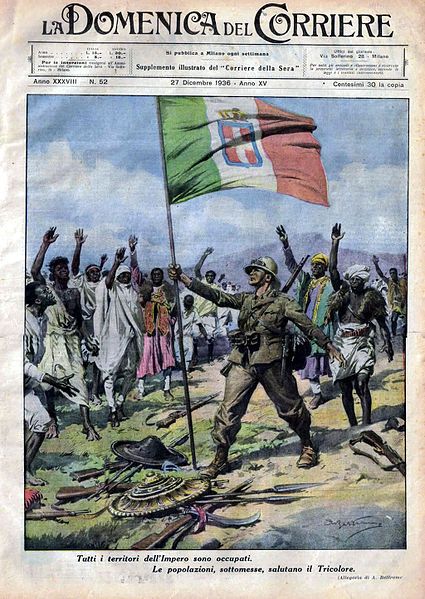
On October 3, 1935, Italian forces attacking from Eritrea in the north and Italian Somaliland in the south invaded Abyssinia, meeting with substantial opposition from the very beginning. Mechanized and motorized forces and aircraft overpowered organized resistance.

Italian armor forces

By May 5, 1936, the Italians had managed to defeat the Abyssinian army and entered the capital of Addis Ababa. Italian forces suffered about 5,000 casualties; most of these were natives serving as part of the Italian force.

With the capture of Abyssinia's capital, the Italians believed their mission accomplished and organized their African possessions into one large colony, Africa Orientale Italia (AOI), which they divided into six governorships. Occupying the territory and controlling all of it turned out to be a different matter: They never succeeded in holding more than half of the country.

There was widespread opposition throughout the countryside that grew in severity. In 1937 an attempted assassination of Marshall Badoglio, the commander of the region, spurred extensive reprisals. This opposition kept up until the Italians were finally driven out in 1941 by the British.

Invasion map
Invasion map
Aside from the military aspects of the campaign, which showed how new technology could be effectively applied against native armies, the war had a political significance on an international scale. The conflict showed very quickly the ineffectiveness of the League of Nations. Further, it demonstrated both splits between what were supposed to be solid allies and the lack of internal resolution of those allies.

On October 10, 1935, the league agreed to impose economic sanctions against Italy as punishment for its unprovoked invasion in direct defiance of the league's rules. The sanctions were not enthusiastically endorsed, although Canada suggested additional oil sanctions be applied.

Part of the problem was that the league's standing did not support strong measures. Another factor was that despite the fact that Abyssinia was a member, many other members considered it to be little more than a very backward region.

In their view, despite the unanimous declaration of 1923, Abyssinia should not be thought of as an independent nation. Also, sanctions were useless unless they were supported by everyone. The United States, which was not a member of the league, increased its exports of oil to Italy at this time.

There were attempts to resolve the crisis by diplomacy of individual nations, but these were not only ineffective but did not reflect well of the proposing nations. In negotiations with the Italians, the British and French offered to let Italy have large parts of the country. Britain would then donate part of British Somaliland, one of its ports, to Abyssinia.

Neither Haile Selassie nor any member of his government was brought into these talks. These negotiations were not looked on well by several members of the league who rightly thought it was rewarding aggression. Thus, the plan died, and Italy continued its war.

Abyssinian emperor Haile Selassie went to the League of Nations for assistance in June 1936. He got nothing for his efforts. Italian claims of atrocities partially undermined Ethiopia's case, although it was clear that the league would not have supported Ethiopia in any event.

The occupation of Abyssinia was not a quiet experience for occupiers or occupied. The Italians brought in the machinery and infrastructure of a colonial government, but nothing went exactly as it had been planned.

For one thing, there was the active opposition of the natives, which never decreased from the day Addis Ababa fell until the British liberated the country. In 1935 Italians opened a concentration camp in Somalia. Eventually, more than 6,000 people from all over the AOI, but principally Abyssinia, were processed there.

Its peak operating period was from the major repression of 1937 until the British arrived in 1941. In 1937 some opponents of the regime were sent to Eritrea and from there on to Italy. In a reversal, political detention camps were opened in the AOI that were used to house Italian political dissidents. There were reported to be mass executions as well.

There were some positive developments. The Italians did bring an improvement in health care. Also, they stopped much of the intertribal fighting that had always plagued Abyssinia. These advantages must be seen, however, against the larger issue of Italy forcefully occupying a nation and repressing its people.

One of the major reforms was a negative one that had to do with education. Italy feared the educated elite in Abyssinia, which they correctly saw as the backbone of opposition. The Italians repressed this elite and also ensured that there would be no schooling beyond the most basic for the general population.

Finally, the area was liberated in 1941 and administered by the British until after the war. Then Italy returned but only as a mandatory power for Eritrea and Somaliland. These countries eventually gained their independence. Abyssinia, more commonly referred to now as Ethiopia, regained its independence with the return of its emperor.

For what started as a colonial venture, the war between Italy and Abyssinia had far-reaching consequences. It demonstrated what military force could do against civilian populations and how far international bullying could go as well as improving the chances for a war in Europe.

Mussolini's popularity and political strength in Italy were improved by the war. In the minds of many, the victory and acquisition of land removed some of the perceived disgrace that came from the consequences of World War I. Mussolini, who often ruled by the creation and management of crises, mobilized a great deal of support for the prosecution of the war.

In addition, the threat of league sanctions helped strengthen popular resolve because the Italian government managed to stir the population into a feeling that it was united against the league, improving the degree of political cohesion, at least for a while. Even the Catholic Church, which sometimes opposed Mussolini's policies, came down publicly in favor of the Italian effort in Africa.

Another development of great significance was the deployment of the technology of destruction. The Italians used their air force extensively in this war. Pioneers in the use of aircraft against ground targets, they had used aircraft in Libya against the Ottomans and later used them against the Libyan natives from 1921 to 1931.

Now, after also leading the world in developing the theory of air power, they showed themselves to be expert practitioners. The latest in modern weaponry was used more widely and ruthlessly than ever against not only combatants but against the civilian population.

The Italians also bombed Red Cross stations, hospitals, ambulances, and civilian targets. In a way, the air attacks on the Abyssinians prefigured not only Guernica but later Warsaw, Rotterdam, and London.

On the continental scale, the war accelerated the political decisions and rivalries in Europe. It destroyed the good will that had existed between Britain and Mussolini's Fascist government. The crisis surrounding the war highlighted and increased the mutual suspicion between France and Britain. That impression was reinforced at Munich in 1938, leading Adolf Hitler and Mussolini into assumptions that would lead them to war in 1939 and 1940.

The alienation of Italy from its former allies and Europe at large brought it closer to Hitler's Germany. At the same time it deepened the contempt that Hitler and Mussolini had for the western powers, in large part because of their inability to do anything constructive.

Finally, it signaled the effective end of the League of Nations as a body capable of protecting small nations from aggression and preventing aggressive war. There had been defections from the league at least as far back as the 1920s based on smaller nations stating that the league was useless in protecting them.

The Japanese invasion of Manchuria in 1931 and the invasion of Abyssinia only demonstrated and reinforced the perceived weaknesses of the league. While the league could point to accomplishments in areas such as improving health of people in poorer nations, it could not stop a war.

Eugenics

Eugenics
Eugenics

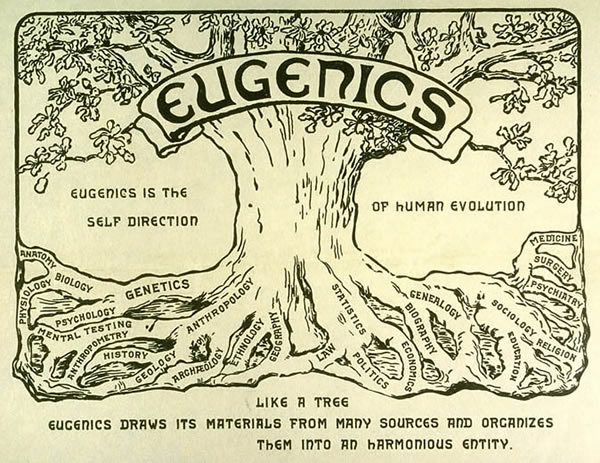
Sir Francis Galton, a cousin of Charles Darwin, coined the term and concept of eugenics in 1883. Eugenics, often defined as "well-born," was an effort to apply Darwinian evolution and Gregor Mendel's recently recognized genetic discoveries to the physical, mental, and moral improvement of human beings.

Eugenics gained many supporters in the progressive-era United States, Canada, and much of Europe. But the concept was riddled with class and racial biases that inflicted harm on thousands of supposedly "inferior" humans. When the excesses of Adolf Hitler's World War II eugenics programs became known, this effort at human engineering fell into disrepute.

Galton was a respected scientist and statistician, but his eugenics notions were based less on evolution than on Social Darwinism, a philosophy that conveniently justified growing inequities in industrializing societies.


Nations could no longer wait for evolution to weed out the weak and stupid; rather, experts would facilitate the process of improving the race, by which most eugenicists meant white northern Europeans.

Positive eugenics tried to encourage "superior" men and women to produce superior offspring. (The Galtons were childless.) Negative eugenics went much further. It proposed to discourage "defective" humans from reproducing at all.

Soon, eugenics agencies and research facilities were springing up. A eugenics laboratory, later named in Galton's honor, was founded at London's University College in 1904. In the United States Charles Davenport created a Eugenics Record Office on Long Island.

U.S. president Theodore Roosevelt, fearing "race suicide," heartily approved of this burgeoning movement to weed out the "unfit." The state of Indiana in 1907 was the first to pass a eugenics sterilization law.

Buck v. Bell, a eugenics sterilization case from Virginia, came before the U.S. Supreme Court in 1927. Speaking for eight of the nine justices, Oliver Wendell Holmes, Jr., ruled in favor of the state.

US Eugenics
US Eugenics

Carrie Buck, he noted, "is a feeble-minded white woman . . . the daughter of a feeble-minded mother ... and the mother of an illegitimate feeble-minded child," adding, "Three generations of imbeciles are enough." By 1933 28 states had sterilized more than 16,000 unconsenting women, men, and children.

In Canada interest in eugenics peaked among English speakers during the Great Depression, when the poor and sick seemed an impossible burden. The Soviet Union and many European nations also promoted fitter families while trying to minimize the "unfit."

Everywhere the poor and uneducated, racial and ethnic minorities, and criminals were overwhelmingly beneficiaries of "genetic cleansing." But none took eugenics as far as Nazi Germany, where Hitler copied many aspects of U.S. eugenics practices and passed laws in the 1930s that foreshadowed the elimination of millions of Jews, Gypsies, gays, and others considered unfit.

In the wake of these atrocities, most eugenics organizations disbanded or rethought their goals. In 1942 the Supreme Court struck down involuntary sterilization of criminals; in 2001 Virginia apologized for Buck and other eugenics interventions.

As genetic science has expanded dramatically, the ethics of genetic improvement remains a very touchy topic. Birth control pioneers Margaret Sanger of the United States and Marie Stopes in Britain were both ardent eugenicists, leading today's abortion foes to distrust the underlying aims of family planning. New technologies raise the specter of prenatal engineering for "perfect" babies—a concept Galton did not precisely foresee but would probably have applauded.

Existentialism

Existentialism
Existentialism

Existentialism is a chiefly philosophical and literary movement that became popular after 1930 and that provides a distinctive interpretation of human existence. The question of the meaning of human existence is of supreme importance to existentialism, which advocates that people should create value for themselves through action and living each moment to its fullest.

Existentialism serves as a protest against academic philosophy and possesses an antiestablishment sensibility. It contrasts both the rationalist tradition, which defines humanity in terms of rational capacity, and positivism, which describes humanity in terms of observable behavior.

Existential philosophy teaches that human beings exist in an indifferent, objective, ambiguous, and absurd context in which individual meaning is created through action and interpretation.


Although there is a diversity of thought in the movement, its thinkers agree that all individuals possess the freedom and responsibility to make the most of life. Existentialists maintain the principle that "existence precedes essence," an observation made by Jean-Paul Sartre (1905–80), atheist humanist and the only selfproclaimed "existentialist." This principle advocates that there is no predefined essence of the human being and that essence is what a human makes for itself.

Each of the existentialist thinkers, however, worked out their own interpretations of existence. Søren Kierkegaard (1813–55), a religious Danish philosopher known as the "father of existentialism," possessed a belief in the Christian God. He attacked abstract Hegelian metaphysics and the worldly complacency of the Danish Church.

Kierkegaard believed that individual existence indicates being withdrawn from the world, which causes individual self-awareness. Individuals despair when confronted with the truth that their finite existence emerged detached from God.

This despair, thus, gives rise to faith, despite the absurdity of that faith. Other philosophical precursors who are believed to have influenced modern existentialist philosophy include St. Thomas Aquinas (1224–74), Blaise Pascal (1623–62), Fyodor Dostoyevsky (1821–81), and Friedrich Nietzsche (1844–1900).

German philosopher Martin Heideger (1889–1976) believed that the starting place for philosophy should be studying the nature of the existence of the human being. In his book Being and Time (1962), he intended to provoke people to ask questions about the nature of human existence. He intended that such questioning would have the result of causing people to live a desirable life and "possess an authentic way of being."

Several French authors possessed existentialist beliefs. Parisian-born Gabriel Marcel (1889–1973) advocated that the purpose of philosophy was to elevate human thinking to the point of being able to accept divine revelation.

He coined the term existentialism in order to characterize the thought of Sartre and his lifelong friend and associate Simone de Beauvoir (1908–86). De Beauvoir, a Parisian existentialist author and feminist, penned She Came to Stay (1943) and The Blood of Others (1945).

These works suggested that the viewpoint of someone else is necessary for an individual to have a self or be a subject. Jean-Paul Sartre, also a Paris native, popularized existentialism in his widely known 1946 lecture "Existentialism and Humanism." The lecture set out the main tenets of the movement.

Taking Sartre's lead, existentialists rejected the pursuit of happiness, as it was believed to be nothing but a fantasy of the middle class. Sartre's existential thought can best be observed in his novels Nausea (1938), credited as the manifesto of existentialism, and No Exit (1943).

Existential thought became further disseminated through Sartre's colleagues, who included Maurice Merleau-Ponty (1908–61) and Albert Camus (1913– 60). Merleau-Ponty sought to provide a new understanding of sensory phenomena and a redefinition of the relationship between subject and object and between the self and the world.

Perhaps the most influential and well-known 20th-century existential writers, Sartre and Camus, also took part in the French Resistance, having been galvanized by the atrocities of World War II. Although the only self-professed existentialist was Sartre, the other thinkers associated with the movement are associated with it because of their similar beliefs.

Camus wrote novels concerned with the existential problem of finding meaning in an otherwise meaningless world and taking responsibility for creating human meaning. He advocated that the chief virtue of humanity was the ability to rebel against the corrupt and philosophically undesirable status quo.

From the 1940s on, the movement influenced a diversity of other disciplines, including theology, and thinkers such as Rudolf Bultmann (1884–1976), Paul Tillich (1886–1965), and Karl Barth (1886–1968), whose 1933 biblical commentary on the Epistle to the Romans inspired the "Kierkegaard revival" in theology.

The principles of existentialism entered psychology through the 1965 work of Karl Jaspers (1883–1969), General Psychopathology, and influenced other psychologists such as Ludwig Binswanger (1881–1966), Otto Rank (1884–1939), R. D. Laing (1927–89), and Viktor Frankl (1905–97).

Other writers who expressed existentialist themes included the marquis de Sade (1740–1814), Henrik Ibsen (1828–1906), Hermann Hesse (1877–1962), Franz Kafka (1883–1924), Samuel Beckett (1906–89), Ralph Ellison (1914–94), Marguerite Duras (1914–96), and Jack Kerouac (1922–69). The work of artists Alberto Giacometti (1901–66), Jackson Pollock (1912–56), Arshile Gorky (1904–48), and Willem de Kooning (1904–97) and filmmakers Jean-Luc Godard (b. 1930) and Ingmar Bergman (1918–2007) also became understood in existential terms.

Henry Ford

Henry Ford
Henry Ford

Henry Ford, the founder of the Ford Motor Company and the man who developed modern factory assembly lines for the mass production of his cars, was born on July 30, 1863, on a farm west of Detroit, Michigan. His father, William Ford, was born in Ireland, and his mother was born in Michigan, her parents having emigrated from Belgium.

As a teenager Ford became fascinated by mechanics, and by the time he was 15 he was well known for his ability to fix watches. His father had expected him to take over the family farm, but he left home to become an apprentice machinist, later returning to the farm, to which he brought some of his new-found skills using a Westinghouse portable steam engine.

He then started working for Westinghouse. In 1891 Ford began as an engineer for the Edison Illuminating Company and two years later was appointed their chief engineer. In 1896 he developed the Quadricycle, a self-propelled vehicle that he test-drove.


In 1903 Ford and 11 others incorporated the Ford Motor Company, which led to the test-driving and then the production of the Model T Ford. It first appeared on October 1, 1908, and had the entire engine and transmission enclosed, as well as having the steering wheel on the left. They were offered for sale at $825, with the price dropping each year.

Anxious to get skilled workers and retain them, he paid a wage of $5 per day from January 5, 1914, doubling the pay of many of his workers (who had previously received $2.34 per day). Previously, staff turnover was such that he had employed 300 men to fill 100 positions. He also reduced the working day from nine hours to eight, gaining himself great loyalty from his staff.

The moving assembly belts in his factories had been introduced in the previous year, and Ford's factories in Detroit and then gradually elsewhere were producing cars so quickly and efficiently that sales passed 250,000 in 1914. Four years later it was reported that half of all cars in the United States were Model T Fords.

Henry Ford with his Model T Ford

Although the initial cars were available in several colors, they were soon all black in color, with the black paint being the quickest to dry, thereby again reducing costs. Ford was later to write that a customer could "have a car painted any color that he wants so long as it is black." By 1927 some 15,007,034 Model T Ford cars had been produced.

At the request of U.S. president Woodrow Wilson, in 1918 Ford contested the Senate seat for Michigan as a Democrat. He supported interventionism and proclaimed himself a strong supporter of the Ford Motor Company.

Soon afterward he turned over the presidency of the Ford Motor Company to Edsel Ford, his son. However, he continued to take part in the running of the company, intervening from time to time.


Ford had high moral values and frowned on heavy drinking and gambling by his workforce. He also was opposed to trade unions operating in his factories. This regularly led to battles between his private security guards and union organizers and their supporters.

With Ford's factories at River Rouge, Detroit, forming the world's largest industrial complex, he also started selling cars overseas and established assembly plants in the 1920s in Germany, Australia, India, and France. By 1929 there were dealerships on all six continents and even a factory constructed in the city of Gorky (modern-day Nizhny Novgorod) in the Soviet Union in 1929.

The depression of the 1930s hurt the Ford Motor Company badly, but the Ford family managed to keep it going. He had a stroke in 1938, when he once again turned the running of the company over to Edsel, and died on April 7, 1947. One of his most famous sayings was "History is bunk."

Francisco Franco

Francisco Franco
Francisco Franco

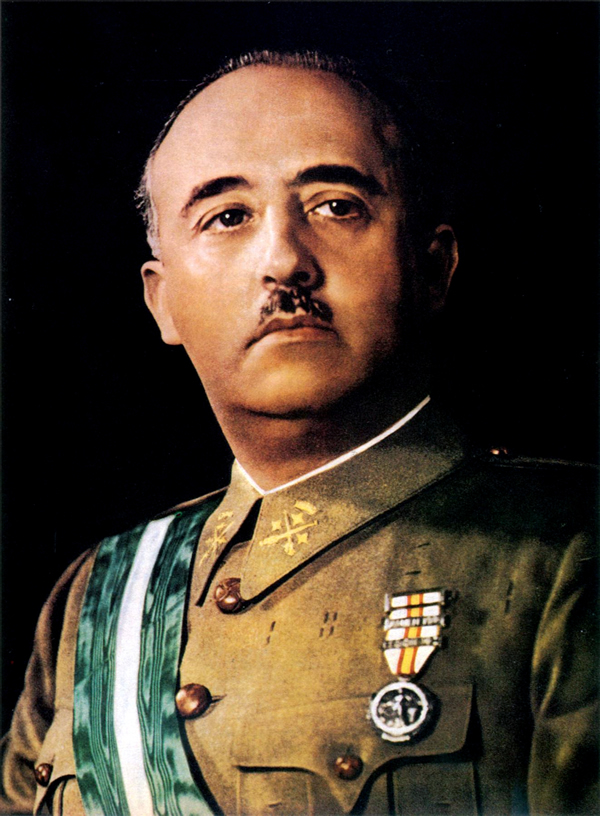
The man who led the nationalists to victory during the Spanish civil war and governed Spain until his death in 1975, Francisco Franco Bahamonde was the longestserving dictator in Europe in the 20th century, narrowly eclipsing the record set by his neighbor, Portuguese dictator António de Oliveira Salazar.

Francisco Franco Bahamonde was born in 1892 in El Ferrol, near Corunna on the Atlantic coast of Spain. It was the country's most important naval base, and his father, Nicolas, worked in the pay corps in the naval arsenal, as had his father before him.

Franco's father was a gambler and drinker, so the upbringing of Francisco Franco and his four siblings was left to their mother, María, who raised the children as devout Roman Catholics.


Franco was six when the Spanish-American War broke out, and it was not long before he saw what was left of the once-proud Spanish navy limp back into El Ferrol following the loss of the Philippines, Cuba, and Puerto Rico. Franco's application to the naval academy was rejected, so he went to the Infantry Training College at the Alcazar in Toledo, near Madrid.

There Franco was initially the smallest boy in his class, but he completed his time there in 1910, the youngest in his graduation year. Commissioned as a lieutenant, he went to Morocco, where he served in the Regulares. This unit, a forerunner of the Spanish foreign legion, was involved in some of the toughest combat against Abd el-Krim.

Promoted to major at the age of 23, Franco was badly wounded in the stomach but miraculously survived. A later account had him threatening to shoot the doctor when the medic decided not to evacuate him because his wound was regarded as too serious.

Returning to Morocco in 1921, Franco led a brilliant action near Melilla, a Spanish-held town on the Mediterranean coast, and was promoted to lieutenant colonel and then gazetted full colonel soon afterward. In October 1923 Franco was asked by King Afonso XIII to escort him when the royal party toured Spanish Morocco.

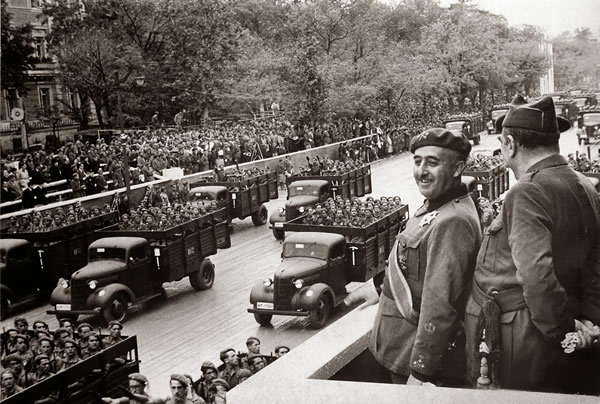
Generalissimo Francisco Franco reviewing his Falangist troops after taking Madrid in 1939

Three years later Franco was promoted by a special decree to the rank of brigadier general, making him, at the age of 33, not only the youngest general in Spain but also the youngest general in Europe since Napoleon.

In 1927 the Spanish finally announced the defeat of Abd el-Krim, and Franco was appointed to head the General Military Academy in Saragossa. The aim of the academy was to create a new Spanish army, and this enabled Franco to inspect a training school at Leipzig.

Franco was courted by the politician Primo de Rivera to stage a coup against King Alfonso XIII, but Franco declined. Primo de Rivera died soon afterward, and when the king visited the academy at Saragossa he publicly embraced Franco and gave the school the right to fly the royal standard. In April 1931 he abdicated the throne, and Spain became a republic.


The first elections during the republic saw a leftwing government come to power. The new government wanted to reduce the influence of the army, and one of the leaders of the republic, Manuel Azana, ordered the closure of the Saragossa Academy. In 1932 there was a plan to stage a military coup, but it never happened.

In the following year's elections, a right-wing coalition government was elected. By now Franco's brother-inlaw, Ramón Serrano Súñer, was a rising politician, and he helped Franco in his next assignment.

Opposing the conservative government, 40,000 miners in Asturias in the north of Spain went on strike, and Franco was sent to put down this revolt. He used Moorish soldiers and brutally crushed the miners' revolt—over 1,000 people died, and many more were thrown into prison.

Many Spaniards were worried by the treatment of the miners and also by the rise of Fascist Italy and Nazi Germany. In February 1936 the elections saw a new left-wing government elected, and the military prepared to stage a coup to bring down this Popular Front government.

The new republican government, worried about Franco, posted him to the Canary Islands. On July 18 Franco was flown to Spanish Morocco, and the army there rose to support him as the generals openly proclaimed their aim to bring down the Spanish government.

With the outbreak of the Spanish civil war the republicans tried to prevent Franco and his men from reaching the Spanish mainland, but an airlift was organized by the Italians and Germans.

Franco then marched his men and their mainland supporters toward Madrid. By the end of July Franco's supporters, the nationalists, controlled a large swath of territory in northern Spain, a pocket around Cádiz, Seville, and Córdoba in the south, and Spanish Morocco.

Franco nearly reached Madrid but diverted his attack to rescue the besieged nationalists at the Alcazar in Toledo. Although this action was highlighted as an "honorable" action in the foreign press, it did allow the republicans to reinforce Madrid and thus prolong the war for another three years.

In October 1936 Franco, by then one of the leading commanders of the rebellion, was proclaimed the supreme commander of the nationalist forces and the chief of state of a nationalist government with its capital at Burgos in northern Spain.

The original leader, General Sanjurjo, had been killed in a plane crash some months earlier. Over the next three years of the war, Franco emerged as a political figure who united his forces into a unified command structure.

The Falange (Spanish fascists), monarchists, Carlists, moderate Catholics, and conservatives put aside their not inconsiderable differences to face the republicans, whose divisions and factional disputes became legendary.

With support from Germany and Italy, Franco's soldiers gradually captured more and more territory from the republicans. Adopting the title caudillo, he portrayed the war as a crusade by which he was to save Spain from Soviet communism, anarchists, and Freemasons. Franco remained a conservative military commander and avoided taking risks.

As a result, he was accused by his own supporters of holding back from delivering a decisive military thrust to allow his men to totally destroy the republicans by attrition. On May 18, 1939, Franco issued his last communiqué of the war, and on the following day he presided over a victory parade through Madrid.

Less than four months after the end of the Spanish civil war, World War II broke out, and with the early German victories it was expected that Franco would declare Spanish support for the Axis.

Even after Italy's entering the war and the defeat of France, Spain remained neutral. On October 12, 1940, Adolf Hitler traveled to the French-Spanish frontier to meet Franco. Franco left San Sebastian for the 30-minute train journey, which took three hours.

Later Franco was to use this to illustrate his reluctance, but it seems more probable that it was to do with the dilapidated state of the railway stock. The meeting went badly. Apparently, Franco wanted control of the French North African colonies as his price for involvement in the war.

Franco also opposed the Germans' establishing bases in Spain, but he did allow submarines to refuel. He also allowed Spanish volunteers to serve on the Russian front and allowed the formation of the "Blue Division," as they were known.

Franco's caution meant that he did not attack Gibraltar, which he could probably have easily captured and which the Germans wanted him to take. However, he did take control of the international city of Tangier— which was returned to international rule at the conclusion of the war.

Although Franco had remained neutral in 1945, Franco's government was treated as a pariah. In December 1946 the United Nations General Assembly condemned Spain and urged its members to withdraw their ambassadors from Madrid. It was not until 1955 that Spain was admitted to the United Nations, and it did not join the North Atlantic Treaty Organization (NATO) until 1982.

Gradually, Franco changed the overt nature of his regime. Although Franco dominated the political scene, the Spanish economy was devastated, and unemployment and underemployment were widespread.

Franco was anxious to get economic aid from the United States and softened his stance in 1947 by holding a referendum on the "Law of Succession" that established Franco as a dictator acting as a regent of the Kingdom of Spain. It was, however, the first time the Spanish people had voted in 11 years.

Franco also started courting Argentina, which was the only country that had flouted the United Nations, request to withdraw ambassadors in 1946. Argentina at that time had not had an ambassador in Madrid, but after the UN vote it hastily filled the vacancy.

Soon afterward it was announced that Juan Perón, president of Argentina, and his wife, Eva, would visit Madrid. Eventually, it was Eva who made the state visit, and this signaled the end of Spain's international isolation.

In 1969 Franco finally named his successor as Prince Juan Carlos de Borbón, with the title prince of Spain. Technically, the father of Juan Carlos had a greater claim, but this also annoyed Carlists, who had supported Franco in the civil war. Four years later Franco gave up the post of head of government but remained head of state and commander in chief of the armed forces.
He died on November 20, 1975, and was buried behind the high altar at the basilica at the Valle de los Caidos (Valley of the Fallen), a church carved into a mountain that officially serves as a memorial for the dead of both sides of the civil war but has long symbolized the nationalist cause.

French Mandate in Syria and Lebanon

French Mandate in Syria and Lebanon

Following the defeat and the subsequent collapse of the Ottoman Empire in 1918, the geographic area of greater Syria came under French mandate rule as stipulated by the League of Nations in 1920.

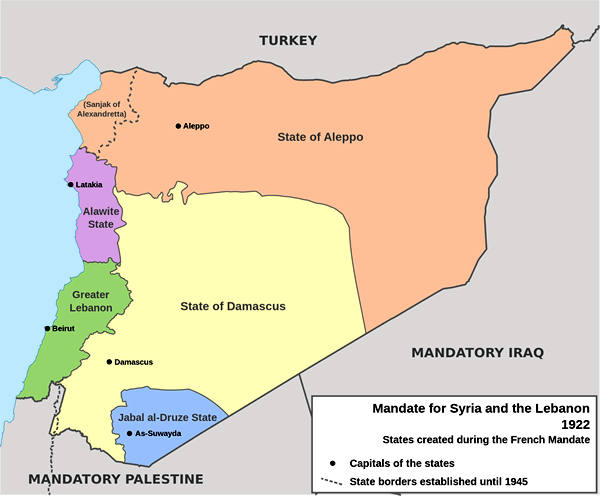
Under French rule, the mandate authority, in addition to expanding the Ottoman Wilayat of Lebanon at the expense of Syria, divided Syria into four new separate districts: Aleppo, Latikia, Damascus, and Jebel Druze. French rule in Syria faced violence, rebellions, and political opposition by the Syrians, who never accepted French domination

The country now known as Lebanon was created on September 1, 1920, by enlarging the Ottoman Wilayat of Lebanon to include previously Syrian-held territory north and south of its borders.


The entity of greater Lebanon (1920–26), as the new state was called, was fashioned after French republican ideals with a constitution and an executive president elected by a parliament.

In 1932 a census was conducted that resulted in the confirmation of 18 religious sects in the country. In an attempt to provide better representation in the government, the results of the 1932 census were incorporated in Article 95 of the constitution, establishing a confessional system.

The Kingdom of Syria (1918–20) was declared soon after the Ottoman army had been defeated in 1918. Headed by the Hashemite king Faysal (also Feisal) I, the kingdom rejected the French mandate.

The opposition to French rule did not end with the demise of the Hashemite Kingdom of Syria. On the contrary, it was fortified by a strong nationalist sentiment, and rebellions periodically erupted throughout the mandate years; these culminated in the Great Arab Rebellion of 1936, which resulted in the French bombardment of Damascus.

In 1940 during World War II, the French overseas territories were controlled by the pro-Nazi Vichy French government. In 1941 British and Free French forces overthrew the Vichy forces and granted Syria and Lebanon nominal independence.

In 1942 parliamentary elections in Syria brought the nationalist National Bloc to power; it began negotiating for independence with the French government. In Lebanon the political elite agreed on a formula to distribute power under the National Pact of 1943.

With U.S. and Soviet recognition, Syrian independence was granted in 1943. Lebanon was also granted independence the same year, but French troops remained stationed in both countries until 1946. Syria celebrated its independence day on April 17, 1946, while Lebanon celebrated independence day on November 22, 1943, and marked withdrawal day on April 17, 1946.