Francisco Madero

Francisco Madero
Francisco Madero

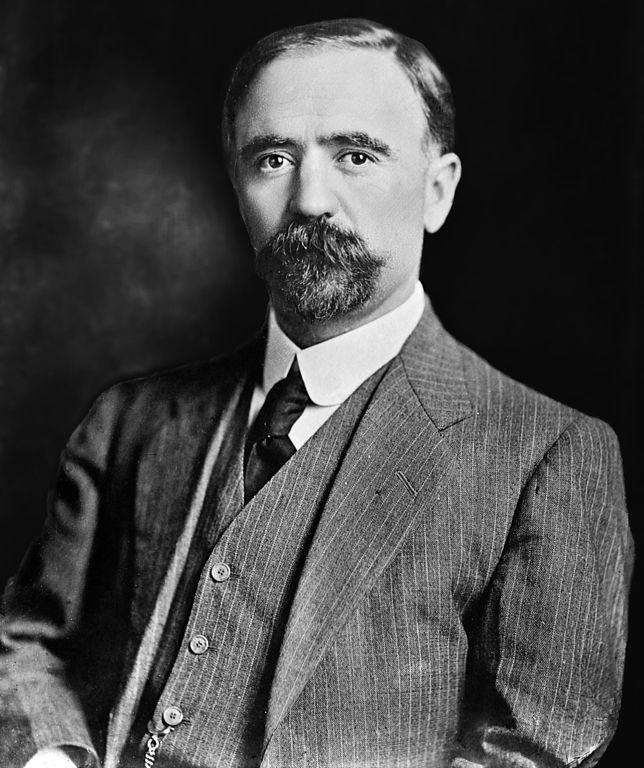
The president of Mexico from 1911 until 1913, Francisco Indalecio Madero González was a prominent revolutionary who was from one of the richest families in Mexico. He was born on October 30, 1873, at Parras de la Fuente, Coahuila, in northeastern Mexico.

His grandfather Evaristo Madero (1828–1911), of Portuguese ancestry, had established massive plantations in the region, becoming fabulously rich and also donating large sums to fund schools and orphanages in the area.

Francisco Madero went to school in Baltimore, Maryland, and then studied in Paris, where he attended the École des Hautes Études Commerciales before studying agriculture at the University of California, Berkeley. Madero came to respect both systems of democracy and was intent on going into politics.


In 1904 Madero organized the Benito Juárez Democratic Club, with himself as the president, and they managed to get a candidate elected in the local municipal elections. In 1905 they decided to contest the next election for governor when the incumbent illegally stood for reelection and protests did not succeed in getting him ousted.

In 1908 the Mexican dictator Porfirio Díaz announced that he would not stand for reelection. He later decided that he would stand, which was unconstitutional. In 1909 Madero wrote The Presidential Succession of 1910, in which he argued for free and fair elections and that rules to stop incumbents from standing for reelection should be enforced.

This led to the formation of the Mexican Anti-Reelectionist Center, with Madero as cofounder. This movement rapidly gained support, and Madero's enemies decided to preempt the result by having him arrested. Madero was charged with stealing a guayule (a crop used in rubber cultivation).

He evaded the police and managed to make it to the convention of the Anti-Reelectionists, where he was chosen as their candidate for the elections. On the eve of the election, Madero was arrested, as were 6,000 other Anti-Reelectionists. Porfirio Díaz was reelected with 196 votes in the electoral college.

As soon as the elections had ended, after being released on a large bail posted by his father, Madero started a campaign against the reelection of Porfirio Díaz. On October 4, 1910, Madero fled to Laredo, Texas. On November 20, 1910, he managed to persuade the people to take up arms and topple Díaz, who, Madero claimed, had subverted the constitution.

Madero also declared that the elections were null and void. He was a better political speaker than a revolutionary leader, and the small force that he brought with him from the United States into Mexico was routed.

His supporters, mainly drawn from the middle class and upper-class elite, were easily rounded up. This meant that Madero had to get help from many other people, some of whom had been traditional supporters of rebellion against the government, including the men who served Francisco "Pancho" Villa.

At one battle Madero held back from sending his men to attack government soldiers at the border town of Ciudad Juárez, and it was left to Pancho Villa and Pascual Orozco to order an assault. At the subsequent Treaty of Ciudad Juárez, signed on May 17, the president's representatives agreed that he would stand down and so end the civil war.

Diaz stood down on May 25, 1911, and Francisco León de la Barra became interim president. In October 1911 a presidential election was held, with Madero standing as presidential candidate. His former vicepresidential running mate, Francisco Váquez Gómez, did not like Madero's plans to stand down the revolutionary forces, and José María Pino Suárez became the new running mate. Madero easily won the elections, and on November 6, 1911, he became president.

As president, Madero introduced many reforms, including the freeing of all political prisoners and the abolition of the death penalty. He also lifted censorship of the press, although this did result in the various factions of his party managing to increase their hostility to each other.

Madero allowed trade unions to organize railway workers, ending the system of giving preference to U.S. workers, and also, through a new department of labor, reduced the workday to a maximum of 10 hours and introduced regulations for the employment of women and children.

His most far-reaching change in the political system was the ending of the jefaturas politicas, party bosses who had controlled various regions, towns, and provinces. They were replaced by nonpolitical municipal authorities who had the tasks of demobilizing the revolutionary soldiers, settling them back into the community, maintaining law and order, and overseeing local and national elections.

In October 1911 Féliz Díaz, the nephew of Porfirio Díaz, staged a revolt to overthrow Madero. In November 1911 Madero became the subject of another rebellion when Emiliano Zapata wanted a considerably more far-reaching agrarian reform program. In addition, some revolutionary soldiers felt that Madero had let them down and had not done enough for his former supporters.

The economy began to stumble, and foreign companies and powerful Mexican business interests began to move against Madero. General Bernardo Reyes staged a third rebellion in December 1911, and Pascual Orozco led a rebellion in January 1912.

Finally, Madero was overthrown in February 1913 when troops led by General Victoriano Huerta fought in the streets for 10 days. Madero was telephoned with the news that his opponents had seized the National Palace and had deposed him, believed to be the first time that a head of state was telephoned to be told of his overthrow. Madero resigned on February 18, 1913, and was executed four days later. He was only 39.

Maginot Line

Maginot Line
Maginot Line

There was never unanimous consensus among military men about the lessons of World War I. When the adversaries of 1914–18 fought again in 1940, the Germans interpreted their experience as one that taught the need for a rapid and forceful offense.

Interpreting that same conflict quite differently, France planned to fight almost purely defensively in the first stages. It would then attack the Germans, who they believed would have worn themselves out assaulting the centerpiece of French strategy, the Maginot line.

Planned in the 1920s and essentially completed by 1935, the Maginot line (named after a French minister of war) was a network of fortifications on the border between Germany, Luxembourg, and Italy. The line was designed and built to serve several purposes.


First, the Maginot line would protect French industry in the Alsace-Lorraine region. Second, a strong defensive line would help the French make the most of their available forces while mobilizing their remaining reserves.

Finally, it was envisioned that the Germans would go directly for the line, allowing the French to hold them off and inflict heavy casualties. The relatively fresh French would then launch an assault of their own and defeat the Germans on their own territory.

The Maginot line was not an uninterrupted line like the trench system of World War I. Instead, it was a network of steel and concrete fortifications facing the Germans to the east and the Italians to the southeast. Each fort (commonly designated as an ouvrage, or work) was an independent structure; in all there were over 100 of these with additional minor fortifications.

maginot line fort diagram

Using guns in a variety of calibers, each fort was within the range of another so they not only could fire on assaulting troops but could also cover other forts in the immediate area. To add further support, there were permanent garrisons of "interval troops," infantry units that would provide support in the areas between forts.

The forts were among the most advanced technical structures of the day. Each had large storage areas for ammunition, facilities for food supplies, command centers, fire control centers, miles of tunnels, small railroads, air-conditioning, electrical power plants, and water supplies. In addition, the guns were mounted in turrets that used a series of complex, highly advanced mechanical devices to change elevation or direction.

The line was strong, it reflected state-of-the-art technologies for the 1930s, and it even made a high degree of military sense. There were, however, drawbacks. Perhaps the most significant of these was that the line did not go all the way to the North Sea.

Maginot line turrets

France did not extend the line for several reasons: the expense, the unsuitability of the terrain, and the appearance that France was abandoning Belgium. In fact, the French believed that while the Maginot line was holding, the newly mobilized French forces would join with the Belgians to contain the German advance.

Together, probably with British assistance, they would then advance through Belgium and eventually invade Germany. At the same time, the French made an assumption that the very northern end of the Maginot line, which stopped near the Ardennes, would be safe, as the Germans would never launch a major offensive through the rough terrain there.

Although war was declared in September 1939, there was no significant action by either side on the western front until May 1940. This period, known as the phony war, allowed the British and the French to mobilize and bring their troops to hold positions without interference by the Germans.

German invasion
German invasion

On the morning of May 10, over 100 German divisions attacked the French, British, Belgians, and Dutch. The main German attack went through the Ardennes forests and mountains in Luxembourg, south of Liege, exactly where the French had assumed it would never take place.

Thus, the German tanks and motorized forces went around the extreme left flank of the Maginot line and straight into France. They bypassed the line and did not attack it directly until after the British evacuation from Dunkirk and the surrender of the French government. The Maginot line forts surrendered only when their mobile interval troops had retreated and they were completely surrounded.

The Germans occupied the Maginot forts but did not maintain them. They used them only briefly when the United States attacked some nearby French cities in 1944 and 1945. After the war the French army reoccupied them and used them. In the years of the cold war, they provided headquarters and communications centers that would have provided significant protection in the case of a nuclear war.

In the years between the world wars, the French were not alone in seeing the usefulness of fortifications. Although they would rely upon a highly mobile and powerful offensive, the Germans maintained two lines, one facing Poland (the East Wall) and one facing France (the West Wall, better known as the Siegfried line, which would be used in 1944 against the United States).

In addition, Czechoslovakia constructed a line of defenses built with French assistance. Finally, Switzerland had built a complex of fortifications. Although not as extensive as the Maginot or German lines, it was well placed, using the mountainous terrain and command of the few lines of communications through the passes.

The Maginot line has become a symbol. On one level it represents a defense that deluded its builders into thinking they need not do anything else but rely upon what seemed to be an impenetrable defense. It has also become a symbol or a shorthand expression for all of the reasons for France's defeat in 1940.

The irony is that had it been used properly, that is, supplemented with an acute understanding of what the enemy might do and not what the French wanted them to do, it might have been a symbol of victory. As designed, the Maginot line worked. It was the rest of France's strategy that failed.

Manchurian Incident and Manchukuo

Map of Manchukuo
Map of Manchukuo

The Manchurian, or Mukden, incident occurred on September 18, 1931. It was a Japanese attack against China and resulted in the establishment of a Japanese puppet state, Manchukuo. This incident was, in fact, the opening of Japan's quest to conquer China that culminated in World War II in Asia.

Japan had sought to control China's northeastern provinces (Manchuria) since the Sino-Japanese War of 1894–95. As a result of its victory in that war, Japan had established a sphere of influence in southern Manchuria.

It had built the Southern Manchurian Railway (SMR), which linked Mukden (or Shenyang), the administrative capital of the region, with Port Arthur, a port leased to Japan at the southern tip of the Liaodong (Liaotung) Peninsula in Manchuria.


Capitalizing on China's weakness during the dying years of the Qing (Ch'ing) dynasty and the early republic, Japan had obtained extensive additional mining and other rights throughout southern Manchuria.

After 1912 this resource-rich region, which is larger than Germany and France combined, had been ruled by a Chinese bandit turned warlord named Zhang Zholin (Chang Tso-lin) and his allies, who survived by complying with Japan's demands.

In 1928 Zhang Zholin, known as the Old Marshal, was assassinated by Japanese officers of the Kwantung Army stationed in Manchuria, who hoped to seize the provinces in the ensuing chaos. However, astute actions of Zhang's supporters ensured a smooth transition of power to his son Zhang Xueliang (Chang Hsueh-liang), known as the Young Marshal.

The Young Marshal sponsored Chinese immigration to his sparsely populated land (approximately 30 million inhabitants in 1930) and undertook economic development projects. He also threw in his lot with the newly established Nationalist government at Nanjing (Nanking) led by Chiang Kai-shek. In 1930

Zhang led about 200,000 of his best troops to help Chiang defeat rebel warlords and remained in Beijing (Peking) to ensure stability in northern China.

Japanese army in Manchukuo

Meanwhile, economic depression had discredited the civilian governments in Japan and swayed many people toward support for the growing rightist, ultranationalist movement centered among ambitious junior military officers.

They formed the Society of the Cherry, the Black Dragon Society, the National Foundation Society, and others that advocated war and expansion as an answer to Japan's problems and saw conquest of Manchuria as the first step toward eventual control of all China and other Asian lands. These Japanese imperialists feared growing Chinese nationalism and the emergence of a strong and unified China and moved to prevent it.

On September 18, 1931, field grade officers of the Kwantung Army staged a minor bombing incident along the railway track of the SMR line just outside Mukden. In a well-coordinated and well-planned act, the Kwantung Army simultaneously attacked over a dozen cities in Manchuria.

Other units from Japan's colony Korea soon joined the action. Too weak to resist militarily, China appealed to the League of Nations and the United States under the Kellogg-Briand Pact. Emergency sessions of the league repeatedly demanded that both sides cease military action.

Both the Chinese and Japanese governments signaled compliance, but the Kwantung Army ignored orders and continued its conquest, to popular acclaim in Japan, forcing the cabinet to fall in December 1931. Japan then set up a puppet government in Manchuria, calling it Manchukuo, meaning "country of the Manchu," and enticed the last Qing emperor, Pu-i (P'u-yi), to become its chief executive and emperor in 1934.

The league dispatched an investigative mission under British diplomat Lord Lytton to Manchuria. Its report, submitted to the league in September 1932, refuted Japanese claims that its actions in Manchuria were motivated by self-defense, branded Manchukuo a puppet state that was completely controlled by Japanese military and civilian leaders, and recommended its restoration to China.

The report was endorsed by the league assembly, with one dissenting vote: Japan's. Japan then resigned from the league, signaling its failure as an effective international body. In 1933 Japanese forces added another Chinese province, Rehe (Jehol), which adjoined Manchuria, to its puppet state. The United States refused to recognize Manchukuo but took no other action.

Japan's government developed Manchuria with a network of modern industries designed to furnish raw materials and finished products to the Japanese economy. They included coal mining, iron and steel works, and manufacturing.

Roads and railways were also expanded to improve the infrastructure and facilitate the transport of goods and products to Japan. Japanese immigration was encouraged, and Japanese were granted privileged status, while the Chinese were strictly and brutally controlled.

Manchuria became an arsenal and a granary for Japan. War with the United States after 1941 resulted in a reduction of the flow of equipment and financing from Japan to Manchuria, causing factory production in the area gradually to grind to a halt. In defeat the Japanese overlords abandoned Pu-i and other Chinese puppets.

Soviet troops poured into Manchuria as World War II ended, stripped equipment and facilities worth over 1 billion 1945 U.S. dollars, and shipped them to the Soviet Union. Japanese arms captured by the Red Army in Manchuria were later transferred to the Chinese Communist army.

Manhattan Project

Manhattan Project
Manhattan Project

The Manhattan Project was a secret U.S. weapons program that applied nuclear technology to create the first atomic bombs. Although other nations, including Great Britain, Germany, the Soviet Union, and Japan, had modest nuclear research programs during World War II, only the United States had the scientific talent, industrial capability, and financial resources to successfully create, test, and eventually use the world's most powerful weapon of the time.

In December 1938 German scientists Otto Hahn, Fritz Strassmann, and Lise Mietner discovered that bombarding an atom of radioactive uranium with neutrons caused its nucleus to split, thereby releasing an enormous burst of energy. This process would come to be called nuclear fission.

The development opened up the possibility for further research into harnessing this energy to be new sources of power as well as the possibility of new, more destructive types of weapons. In the 1930s the scientific community involved in nuclear research was international in character and included contributions from both Europe and North America. By 1939 political tensions in Europe caused many scientists to congregate in the United States and Britain, including many émigrés from Germany and Italy.


Work on using nuclear fission for military applications began in Germany on April 29, 1939, when the Reich Ministry of Education convened a secret conference and created a new research program. Germany also banned the export of uranium, an essential and rare element needed for this research.

In 1939 Leo Szilard, a Hungarian émigré physicist, understood the military potential of nuclear fission and the danger if Germany harnessed this power. Szilard went to the United States to enlist the help of Albert Einstein, at that time the most famous scientist in the world.

In August 1939 Einstein wrote a letter to President Franklin D. Roosevelt warning that a weapon based on nuclear fission was possible and that Germany could be in the process of constructing such a weapon. Einstein further urged the president to begin a project to develop an atomic bomb. Roosevelt responded by creating a committee to study the military implications of nuclear physics.

Manhattan Project warning sign

In December 1941, after the Japanese attack on Pearl Harbor, the United States went to war with Germany, Japan, and Italy. During the war the fundamental military strategy of the United States was to achieve complete victory at the lowest cost to U.S. lives. U.S. officials believed that an atomic bomb could shorten the war and reduce the number of U.S. casualties.

By early 1942 British scientists concluded that a uranium weapon was feasible. Based on these reports the secret weapons program was put under the auspices of the U.S. War Department and was code-named the Manhattan Engineer District, more commonly known as the Manhattan Project, because it originally was to be headquartered in New York City.

In September 1942 army general Leslie Groves was named director. Groves soon appointed J. Robert Oppenheimer, a theoretical physicist from the University of California at Berkeley, scientific director.

The project soon encompassed a crew of over 100,000 people, involving 37 installations in 13 states, and more than a dozen university laboratories. Secrecy was considered to be of the utmost importance. In fact, many of the scientists and engineers were given only information that immediately affected their work, and they therefore were unaware of the larger implications of their research.

On December 2, 1942, a team led by Enrico Fermi, a Nobel Prize–winning physicist émigré from Italy, created the first controlled, self-sustaining nuclear chain reaction at the University of Chicago. This proved that an atomic bomb many times more powerful than conventional weapons was possible.

The project focused on two main tasks. The first was the design of the bomb. Most of this work was done at the Los Alamos weapons lab in New Mexico under the direct supervision of Oppenheimer, who supervised the actual design and construction of the bomb. The other task, the production of nuclear fuel, was undertaken at a site in Oak Ridge, Tennessee, that focused on isolating uranium isotopes.

Although the Manhattan Project had originally been conceived to combat a potential German nuclear weapon, work on the bomb would continue after Germany surrendered on May 8, 1945. U.S. officials were determined to use the bomb against Japan in order to end the war at the earliest possible moment with the fewest casualties.

Secretary of War Henry Stimson told President Harry S. Truman that the bomb could create problems for the United States because it could not maintain a monopoly on the technology. Stimson requested that Truman convene a special committee to consider the implications of the new weapon.


Truman agreed, and the Interim Committee, made up of high-level advisers, held five meetings between May 9 and June 1, 1945. The committee debated the most effective use of the bomb in order to expedite a Japanese surrender.

The committee determined that the weapon should be employed without prior warning, which would increase its psychological impact. The committee suggested that the purpose of the bomb should be to impede the Japanese capacity to wage war and to shock the Japanese with the overwhelming destructive power of the bomb.

Political Implications

The committee also debated the effects of the bomb on postwar international relations. Although the Soviet Union remained aligned with the United States and Great Britain, tensions between the Allies continued to grow, especially over Soviet control of Eastern Europe. The committee fully realized that the bomb could increase the already tense relationship with the Soviet Union.

The committee discussed two ways of handling the issue. The first would be to offer general information to the Soviets about the bomb in order to increase cooperation between the two allies. The other approach would be to use the bomb to gain diplomatic advantages in U.S. dealings with the Soviets, at least for the short term.

The committee was opposed to even providing general information on the bomb to the Soviets and determined that the United States should work to ensure that it stayed ahead of the Soviet Union in the research and production of nuclear weapons.

Truman accepted the committee's findings. For several months Truman had delayed a conference with Joseph Stalin and Winston Churchill until after a successful test of the plutonian bomb, planned for July, believing that a successful test would improve his bargaining position.

On July 16, 1945, the United States successfully exploded the first nuclear bomb in a test code-named Trinity at Alamogordo, New Mexico. The force of the bomb equaled 18,600 tons of TNT, approximately 2,000 times more powerful than the British "Grand Slam," the largest conventional bomb used in World War II.

Ultimatum

15-kiloton uranium bomb nicknamed Little Boy

At the end of the conference the Allies presented an ultimatum to Japan in what is known as the Potsdam Declaration. The declaration called on Japan to unconditionally surrender to the Allies or face "prompt and utter destruction." The United States elected not to specifically refer to the atomic bomb by name.

After Japan refused to surrender, Truman made the decision to drop atomic bombs on the Japanese home islands. The Manhattan Project instituted Project Alberta, which involved the wartime delivery of the completed bomb. Research groups were sent to Tinian, an island in the Pacific, which was the base from which the planes carrying the atomic weapons would ultimately depart.

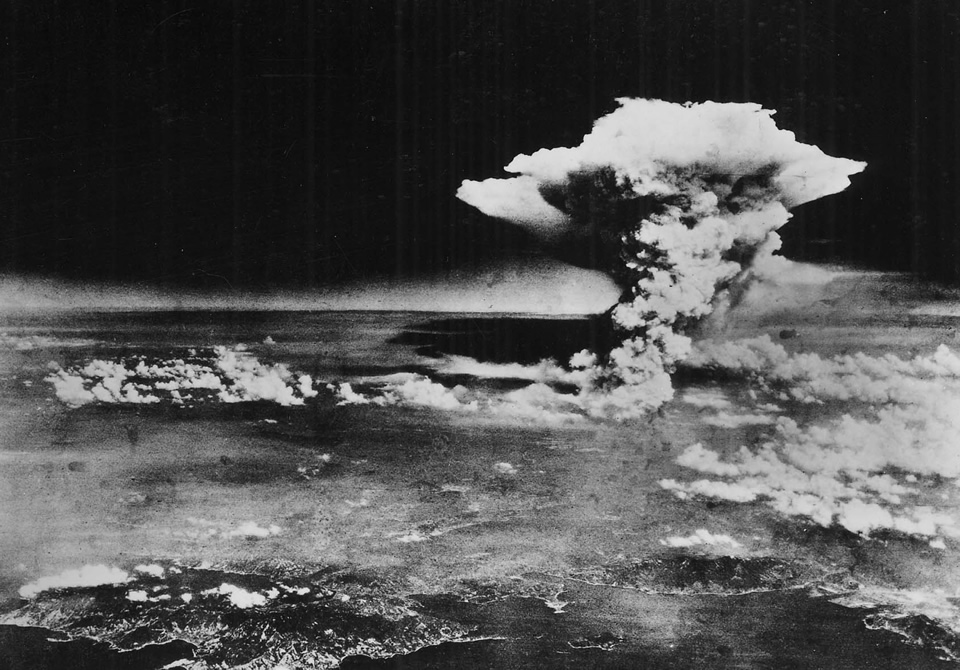
On August 6 at 8:15 a.m., the Enola Gay, piloted by Brigadier General Paul W. Tibbets, released a 15-kiloton uranium bomb nicknamed Little Boy 31,060 feet over the city of Hiroshima, Japan; 43 seconds later the bomb exploded 1,900 feet above the city.

Atomic bombing of Hiroshima

Witnesses reported seeing a searing flash of light, hearing a deafening roar, and feeling a massive rush of air. The 4.4 square miles surrounding the point of detonation were completely destroyed. Estimates suggest that over 60,000 people died immediately, while possibly 70,000 more were to die over the next few years, many from acute exposure to radiation.

Three days later, on August 9, Bock's Car, piloted by Major Charles Sweeny, dropped a 21-kiloton bomb nicknamed Fat Man on Nagasaki. Originally, the mission had been to bomb the Japanese city of Kokura, but the crew was unable to do so because of a heavy haze.

Instead, the plane went to its secondary target. Estimates suggest that 38,000 were killed immediately, with an estimated 35,000 additional fatalities as a result of injuries sustained during the bombing.

In the aftermath of the bombings and the Soviet invasion of the Japanese colony of Manchuria, Emperor Hirohito broke a deadlock in the Supreme Council to accept the Potsdam Declaration as the basis for the Japanese surrender.

The sole Japanese condition was that the emperor be allowed to retain his throne as titular ruler of the people. The Japanese government accepted the terms of surrender on August 15 and formally surrendered to General Douglas MacArthur in Tokyo Bay aboard the battleship USS Missouri on September 2.

Mao Zedong (Mao Tse-tung)

Mao Zedong (Mao Tse-tung)

Mao Zedong was the son of a prosperous farmer from the Hunan Province in central China. After graduating from normal school he worked as a library assistant at National Beijing (Peking) University, where he came under the influence of intellectuals disillusioned with Western democracies and turned to Marxism, hailing the success of the communist revolution in Russia.

Mao joined a Marxist study club organized by faculty leaders of Beijing University Chen Duxiu (Ch'en Tuhsiu) and Li Dazhao (Li Ta-chao). In July 1921 he was one of 12 men who formed the Chinese Communist Party (CCP) in Shanghai; Chen was elected general secretary of the party.

In January 1923 the father of the Chinese republic, Sun Yat-sen, formed a (First) United Front with Soviet representative Adolf Joffe under which the Soviet Union gave advice and aid to Sun's Kuomintang (KMT, Nationalist Party) in return for admission of members of the CCP to the KMT.


As a result, Mao was elected a reserve member of the Central Executive Committee of the KMT and made head of the farmers' organization in the United Front government in Canton. Mao participated in the Northern Expedition led by Chiang Kai-shek against the warlords and helped rouse the peasants in Hunan against the warlord regime and economic inequities. In 1927 Chiang Kai-shek purged the CCP from areas under his control. Mao escaped to the hills of Jiangxi (Kiangsi) Province in central China.

Between 1927 and 1933 Mao and other Communists who fled the Nationalist dragnet established a Chinese Soviet Republic in the hills of Jiangxi, where they implemented violent land reforms while their Red Army, under commander Zhu De (Chu Teh), fought off KMT armies sent against them.

However, decisive defeats by an army personally led by Chiang forced the battered CCP to flee in the Long March, which lasted a year (1934–35). Mao consolidated his power in a conference at Zungyi (Tsungyi) during the flight and maintained it throughout the subsequent Yanan (Yenan) period of the CCP.

Although Yanan's location in remote northwestern China bought the CCP time, the outbreak of the Sino-Japanese War ensured its survival because it forced the KMT to call off its anti-Communist campaign and form a Second United Front. The CCP grew explosively during the eightyear war (1937–45). Mao wrote extensively during the war and mapped out strategies for future victory against the KMT.

Civil war broke out almost immediately after the defeat of Japan. After the United States failed to mediate a cease-fire, it withdrew support from the KMT government. A combination of many factors led to the KMT's defeat in 1949 and the establishment of the People's Republic of China, which Mao led as chairman of both the CCP and the government.

Moa Zedong propaganda poster

China became allied with the Soviet Union, received Soviet aid, and followed its model of land collectivization and industrialization. Impatient to surpass the Soviet Union, Mao inaugurated in 1958 the Great Leap Forward, which dragooned the people into communes and wrecked the economy with wildly unrealistic programs. 

As a result, about 30 million people died in a Mao-made famine, the greatest in human history. Mao's pragmatic colleagues then forced him to give up his chairmanship of the government in 1959 and began repairing the catastrophically broken economy.

Mao fumed in impotence between 1959 and 1966, then formed a coalition with his wife, Jiang Qing (Chiang Ch'ing), young students, and army leader Lin Biao (Lin Piao) and launched the Great Proletarian Cultural Revolution in 1966.

The student Red Guards ousted the pragmatists, wreaked havoc throughout the land, and returned Mao to power in a cult of personality that rivaled Soviet leader Joseph Stalin's. China did not begin recovery from the disastrous Cultural Revolution until the increasingly sick and senile Mao died in 1976.

March on Rome

March on Rome
March on Rome

The October 1922 March on Rome entered into the mythology of Benito Mussolini's National Fascist Party as the moment when the Fascists conclusively demonstrated their power over the Italian government and people.

In fact, they had already displayed their collective ability to destroy law and order, to undermine parliamentary rule, and to attract the support of Italians fearful either of falling out of the lower middle class or of losing their extensive property holdings pending a socialist revolution.

Thus, the march symbolized the transfer of power and authority that had already occurred when the king had refused to proclaim martial law against the Fascists and had then invited Mussolini to become prime minister.


Immediately after World War I, Italians received universal suffrage. Electoral politics acquired a new tone as peasants and workers began to vote. The failure of the Popular Party and the Italian Socialists (PSI) to cooperate in the chamber of deputies, despite their shared concern for Italy's poor and working class, created an opportunity for Mussolini and fatally weakened parliamentary democracy in the country.

In the elections of 1920, the PSI had acquired control over Milan, Bologna, 25 provincial councils, and 2,200 district councils. These victories dislodged and irritated traditional elites. Some smaller landed proprietors also sympathized with the Fascist efforts to eviscerate the PSI, as many had managed to secure land only in recent years and feared that they would have it taken away.

Given the notable labor strife and class conflict in urban, industrialized areas, Mussolini attracted the support of major industrialists, including Alberto Pirelli and Giovanni Agnelli (Fiat).

Meanwhile, nationalists continued to harbor bitter feelings about the government that had accepted the Treaty of Versailles, which had awarded Italy almost none of the territory that it had expected to gain upon allying with the Triple Entente during World War I.

They wanted to erase memories of the snubs suffered by Italy at the hands of her erstwhile war partners. A large number of veterans and lower-ranking soldiers undertook paramilitary activities on behalf of the Fascists as well as appearing in Fascist rallies.

By late 1920 the Fascists had control over life in much of northern Italy. Local Fascist leaders such as Italo Balbo used intimidation to wrest control of cities and towns from elected socialist governments. By mid-1921 the Fascist militias were often assistants to the official police forces.

Conservatives and government officials generally ignored the Fascist contributions to public violence; indeed, many appreciated the militancy and virility of the Fascists as crucial to the restoration of Italian national honor.

Mussolini adeptly shifted his rhetoric and program in the interests of retaining his new group of supporters. He virtually eliminated references to class conflict and social revolution, replacing them with evocations of the need for discipline and strong leadership in Italy.

The queen mother and the duke of Aosta avidly supported the Fascist movement. He also placated the Roman Catholic Church by avoiding anticlerical rhetoric and by cultivating good relations with the new pope, Pius XI (elected in 1922), who worried about communism far more than any possible threat from the Fascists.

Having amassed such support among propertied and influential Italians, Mussolini could contemplate seizing power. This proved unnecessary, however, since the existing government had already lost control over the country.

While heading to Naples for the Fascist Party Congress in late October 1922, Mussolini threatened that the Fascists would seize power following a mass march to Rome if they did not receive at least five ministerial posts. Prime Minister Facta asked the king to declare martial law in order to prevent such a march, but the king refused.

Instead, he suggested a coalition government. Mussolini rejected the proposal, anticipating a complete victory if he was patient. This expectation was fulfilled on October 29, 1922, when King Victor Emmanuel asked him to form a government.

The March on Rome of approximately 30,000 Fascists thus served little practical purpose except as a celebration of having achieved power. Mussolini himself reached the outskirts of Rome by rail. Wearing a suit and walking into Rome at the head of his ill-clad band of Fascists, Mussolini looked every inch the bourgeois politician on whom the traditional elites of Italy could rely.

José Carlos Mariátegui

José Carlos Mariátegui

José Carlos Mariátegui was the founder of the Socialist Party of Peru, which was later transformed into the Communist Party of Peru. He was also one of the more influential social theorists in Latin America.

José Carlos Mariátegui was born on June 14, 1894, at Moquegua, a dry, dusty town on the outskirts of the Atacama Desert, close to Peru's southern border with Chile. It was 11 years after Peru's disastrous war with its southern neighbor.

His father was Francisco Javier Mariátegui Requejo, a grandson of Francisco Javier Mariátegui (1793–1884), one of the original signatories of Peru's declaration of independence in 1821. When José Carlos Mariátegui was a young boy, his father abandoned the family and left his mother, María Amalia La Chira Ballejos, to look after the three children.


They moved to Lima and then to the town of Huacho, north of Lima, close to where San Martín had proclaimed Peru's independence. When he was eight José Mariátegui suffered a bad injury to his left leg and spent four years in a hospital in Lima. When he was 14 he started working for the newspaper La Prensa, initially running errands, then becoming a linotypist, and ending up as a journalist.

He also found work with the magazine Mundo Limeno. In 1916 Mariátegui decided to leave La Prensa to join a new slightly left-wing daily newspaper called El Tiempo. By this time he had been heavily influenced by the Spanish socialist Luis Araquistán.

After two years Mariátegui had sufficient confidence to leave El Tiempo and try to establish his own magazine but had trouble getting anybody to agree to print it. He then decided to establish his own paper, La Razón, which was the first avowedly socialist paper in Peru.

In May 1919 La Razón supported a strike held to try to get legislation restricting work to an eight-hour day. It also wanted price controls for basic goods. This rapidly began to annoy the president, Augusto B. Leguía y Salcedo, who decided to defuse the matter by forcing Mariátegui to take a government scholarship to study in Europe. As a result, Mariátegui left to go to Europe in 1920. After a brief time in France, Germany, and Austria, he moved to Italy and there married Ana Chaippe, returning to Peru in 1923.

Very soon Mariátegui was becoming well known as a Marxist and also a friend of Víctor Raúl Haya de la Torre, who led the American Popular Revolutionary Alliance. Together they worked on Claridad, a Marxist magazine, and when Haya de la Torre was deported Mariátegui remained as editor, dedicating its fifth issue, in March 1924, to Lenin.

Personal tragedy was to strike soon afterward when he had to have his left leg amputated. However, he struggled on and in the following year, 1925, wrote La escena contemporánea (The contemporary scene), a collection of essays on the problems facing the world at the time.

In the next year he was running the magazine Amauta, which projected his ideas of socialism and Latin American culture throughout South and Central America. He was arrested in 1927 and placed under house arrest by Leguía.

Initially, Mariátegui planned to move to Buenos Aires or Montevideo but in the end he decided to stay in Lima, where he established the Socialist Party of Peru in October 1928, with himself as general secretary.

This political party later became the Communist Party of Peru. As he was formalizing his ideas, also in 1928, Mariátegui wrote Seven Interpretive Essays on Peruvian Reality, which covered the social history of Peru from a Marxist standpoint. In 1928 and 1929 Mariátegui founded and edited the journal Labor, about the labor movement in Peru.

Mariátegui helped in the founding of the General Confederation of Peruvian Workers in 1929, and this body was represented at the subsequent Constituent Congress of the Latin American Trade Union Conference, which was held at Montevideo. Mariátegui died on April 16, 1930, from complications that resulted from his injury to his leg. He was 35 years old.