Open Door Policy

Open Door Policy
Open Door Policy

China's catastrophic defeat in the Sino-Japanese War (1894–95) and its growing political and military weakness led to a scramble for concessions by Western powers that seemed to presage its eventual partition.

The movement began in 1898 with Germany's successful demand to the Qing (Ch'ing) government for a 99year lease of Jiaozhou (Kiaochow) as a naval base in Shandong (Shantung) Province, the right to build a railway between that port and Jinan (Chinan), the provincial capital, and numerous mining and other rights. Shandong became a German sphere of influence as a result.

Russia followed by obtaining similar privileges and concessions in the northeastern provinces (Manchuria) and Mongolia, and France in the south and southwestern provinces (Guangdong, Guangxi, and Yunnan) that adjoined French Indochina.


Great Britain dominated China's foreign trade, amounting to 60 percent of its total imports and exports. While it feared the division of China into spheres of influence would damage British trade, it nevertheless moved to establish a sphere in the Yangzi (Yangtze) River valley and in areas near Hong Kong.

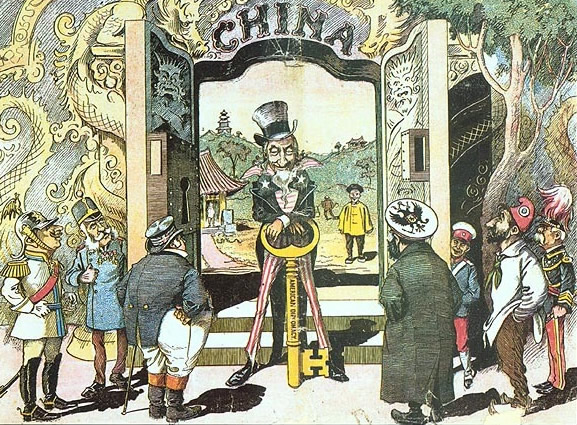
The United States had not demanded a sphere of influence in China, did not have major trading interests in China, but feared that Western powers might impose discriminatory tariffs in areas under their influence.

These concerns prompted W. W. Rockhill, private adviser on Far Eastern affairs to Secretary of State John Hay (1838–1905), to draft a memorandum, with the assistance of British diplomat Alfred E. Hippisley, that Hay sent in September 1899 to the governments of Great Britain, Russia, Germany, France, Italy, and Japan.

This, the First Open Door Note, had three points: First, no country would interfere with the interests of others in its sphere of influence; second, no country would discriminate against the nationals of other countries by charging them different railway and harbor dues; and third, tariffs stipulated by treaties would be collected by the Chinese government within Western spheres of influence.

Despite receiving evasive and equivocal replies and no unqualified support from any country, Hay nevertheless announced on March 20, 1900, that all had given their "final and definitive" assent.

The Boxer Rebellion in China precipitated an international intervention in 1900 that threatened to carve up the country. Thereupon, Hay issued the Second Open Door Note on July 3, 1900, in which the United States stated its goal as: to "preserve Chinese territorial and administrative integrity, protect all rights guaranteed to friendly powers by treaty and international law, and safe guard for the world the principle of equal and impartial trade with all parts of the Chinese Empire." Hay did not solicit responses from the other powers on this declaration of principle.

The Open Door policy became one of the cornerstones of U.S. policy regarding China. It was embodied in the Washington Nine Power Treaty in 1922 and the Stimson Doctrine of Non-Recognition of Japan's conquest and installation of a puppet government in Manchuria after 1931.

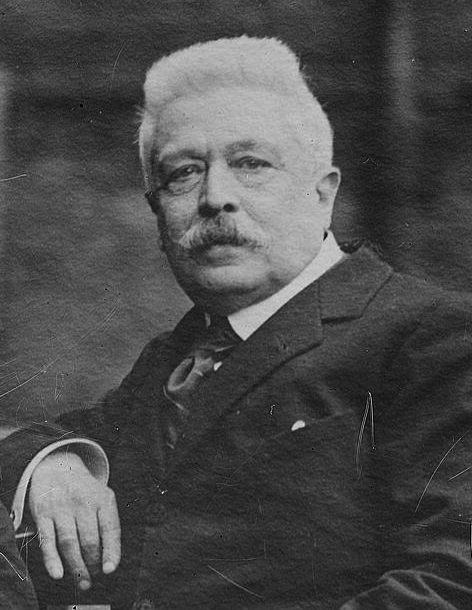
Vittorio Emanuele Orlando

Vittorio Emanuele Orlando

Vittorio Emanuele Orlando was prime minister of Italy from 1917 to 1919 following the Italian army's defeat at Caporetto. Orlando was also head of his country's delegation to the Paris Peace Conference in 1919. Aside from his prominent political role, Orlando, who was himself a professor of law, is also renowned for his writings on judicial issues.

Orlando was born on May 19, 1860, in Palermo, Sicily, where he was also raised and educated. He made a name for himself through his writings on government administration and electoral reform. In 1897, he was elected to the chamber of deputies, the Italian federal parliament.

From 1903 to 1905, Orlando served as minister of education under King Vittorio Emanuele (Victor Emanuel) III. In 1907, Orlando was appointed minister of justice, a portfolio he retained until 1909. He was subsequently reappointed to the same ministry in November 1914, and he became minister of the interior in June 1916.


Italy remained neutral during the initial phase of World War I. The country was formally aligned with Germany and Austria-Hungary; a discussion started over whether Italy should enter the war on the Entente's side. Orlando was a strong proponent of Italy's entrance into the war, which took place when the kingdom declared war on Austria-Hungary in late May 1915.

Always a strong supporter of Italy's participation in the war even after initial setbacks on the battlefield, Orlando was encouraged in his support of the Allies on the basis of secret promises made by the latter granting vast Italian territorial gains in the Mediterranean.

On October 30, 1917, Orlando became prime minister. It was a time of severe crisis following the disastrous defeat of the Italian troops at the Battle of Caporetto by the Austrians. With his appointment as prime minister having boosted national morale and having successfully rallied Italy to a renewed war effort, Orlando replaced the stubborn general Luigi Cadorna as chief of general staff with Armando Diaz. The following year saw Italian successes on the battlefield and the war's victorious conclusion in November.

Orlando served as prime minister until the end of the war and headed the Italian delegation at the Paris Peace Conference in 1919. However, he proved unable to obtain the expected and promised territorial concessions.

Orlando had a serious clash with his allies, especially President Woodrow Wilson of the United States. Orlando's claims to formerly Austrian territory collided with Wilson's policy of national self-determination.

Wilson even appealed over Orlando's head to the Italian people on the question of the Mediterranean port of Fiume/ Rijeka, which was requested by both Italy and Yugoslavia. Although that maneuver failed, Orlando dramatically left the conference in April 1919, returning only to sign the resultant treaty the following month.

His position rapidly undermined by his apparent inability to get concessions from the Allies and to secure Italian interests at the peace conference, Orlando resigned from office on June 19, 1919. He was succeeded by Francesco Nitti.

On December 2 of the same year, Orlando was elected president of the chamber of deputies. In the rising conflict between the new Fascist Party of Benito Mussolini and the workers' organizations, Orlando at first supported the Fascists.

He remained a supporter of Mussolini's government upon its inception at the end of 1922, although he changed his position two years later when the prominent Socialist leader Giacomo Matteotti fell victim to assassination. In 1925, Orlando resigned from parliament in protest against Fascist electoral fraud, serving thereafter in the constituent assembly.

Orlando remained in retirement until Mussolini's fall in July 1943. After the liberation of Rome in early June 1944, Orlando became a leading figure of the newly established Conservative Democratic Union. He was elected president of the constituent assembly in June 1946.

Orlando's objections to the peace treaty brought about his resignation in 1947. The following year saw his election to the new Italian senate. The same year he was also a candidate for the presidency of the republic, but he was defeated by Luigi Einaudi. He died on December 1, 1952.

Pascual Orozco

Pascual Orozco
Pascual Orozco

Pascual Orozco served as an important military and political leader in Mexico from 1910 to 1915, ultimately becoming a leading figure of the Mexican Revolution. Born in the northern state of Chihuahua in 1882 to a politically active family, Orozco received a few years of primary education and worked in his father's store until becoming a muleteer, transporting ore from local mines.

His transportation business prospered, and by 1910 he owned his own team of mules and a retail store and was known as a successful businessman with a good reputation as an honest man.

Orozco's political consciousness awoke with his father's opposition to the regime of Porfirio Díaz. Pascual Orozco, Sr., supported the activities of the Mexican Revolutionary Party, one of the earliest groups to oppose Díaz.


In 1910 Abraham González, the revolutionary leader of Chihuahua and a supporter of Francisco Madero, picked Orozco to be the military leader of his home region of Guerrero. Orozco's reputation as an honest and efficient businessman facilitated recruitment to the revolutionary cause.

On November 10, 1910, Orozco initiated his military offensive, beginning operations the day before the official date set by Madero for the revolution to begin. On November 29 Orozco's forces took Pedernales, Chihuahua, the first significant rebel victory over the federal army.

Orozco rose in the ranks to a leadership position, commanding revolutionary activities in the state of Chihuahua, which were marked by several triumphant engagements with Díaz's forces. Francisco Madero returned to Mexico and joined Orozco in February 1911, assuming command of military operations.

After a devastating defeat at Casas Grandes, Chihuahua, undertaken without Orozco's knowledge, Madero recognized the talent of his Chihuahuan military leader and promoted Orozco to the position of colonel in the revolutionary army.


In May 1911 Orozco and Francisco "Pancho" Villa prepared to attack Ciudad Juárez, a metropolitan center located on the U.S.-Mexico border directly opposite El Paso, Texas. Madero feared the attack could spill over into El Paso, leading to U.S. intervention. He subsequently ordered Orozco and Villa to call off the attack; they ignored orders and forced the city into surrender.

Orozco captured the federal commander at Juárez, General F. Navarro, with hopes that the general would be court-martialed for executing some of Orozco's troops. Madero disagreed and aided Navarro in escaping to the United States.

The attack on Ciudad Juárez created tension between Madero and Orozco, tension that reached an apex when Madero failed to reward Orozco for his vital services to the revolutionary cause with the position of governor of Chihuahua or minister of war. Orozco was appointed to the position of commander of the rural guard of Chihuahua, a modest position, and later became the head of the garrison stationed at Juárez.


He resigned this position in February 1912 after Madero ordered him to quell the Zapatista rebellion in the south, but Madero refused his resignation. Orozco suppressed one more uprising in the north and resigned again.

Feeling that his talents and contributions to the revolution and Madero's presidency went unrecognized and with the financial backing of oppositional political factions in Chihuahua, Orozco openly denounced the Madero government.

Madero's oversight of Orozco's contributions to his rise to power now put the new president into open rebellion with his most successful rebel leader. Chihuahua raged with violent revolt, and the governor of the state fled for his life.

Madero's new government struggled to put down the rebellion and found its coffers drained and its attention taken away from reform projects by the focus on stabilizing the country, especially the north. Madero dispatched General Victoriano Huerta to put down Orozco's rebellion in April 1912. Huerta succeeded in taking back Ciudad Juárez but did not capture Orozco.

A turn of events in February 1913 left Huerta president of Mexico by way of a military coup and Madero's assassination. Huerta needed military support to overcome resistance to his seizure of power and looked toward Orozco as an important ally.

In exchange for financial demands and a program of agrarian reform, Orozco became a brigadier general in Huerta's army. In May 1913 Orozco began his northern campaign against Huerta's enemies, experiencing a series of victories, which led to his promotion to general of brigade.

He battled Pancho Villa for control of Chihuahua, but disagreements with fellow general Salvador Mercado over political and military affairs ultimately contributed to the defeat of the federal forces. Huerta dispatched Orozco again in April 1914 to Chihuahua to create a base for guerrilla operations, but Huerta's resignation and exile in July 1914 dissolved that operation.

With this change in government, Orozco did not wait for a new administration to revolt. This time, however, he lacked popular support, and within two months he no longer represented a military threat. Now in the United States, Huerta courted Orozco in his scheme to take back the Mexican presidency. Orozco agreed to meet Huerta at Newman, New Mexico, to discuss the conspiracy.

Federal agents had been monitoring Huerta, and the two men were arrested and charged with conspiracy to violate U.S. neutrality laws on January 13, 1916. Orozco escaped federal custody on July 3 but was killed on August 30 by a posse made up of U.S. federal marshals, Texas Rangers, and U.S. Army troops. Some characterized Orozco's death as an execution, finding it odd that Orozco and his four companions were all shot, while the posse suffered no losses or injuries.

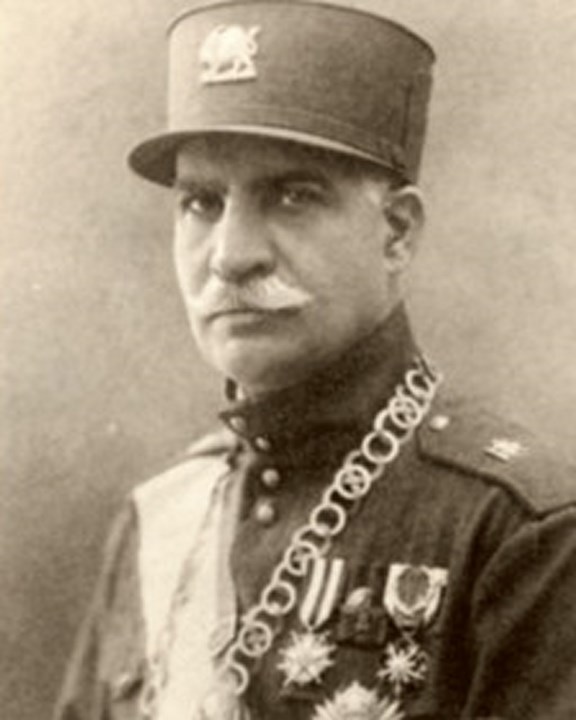
Pahlavi Dynasty and Shah Reza Khan

Shah Reza Khan
Shah Reza Khan

At the end of World War I, Iran was in desperate straits. The authority of the central government had broken down, and the country faced national bankruptcy in addition to famine in some regions. In 1919 the majlis (parliament) declined a British offer of financial and military assistance, and British support personnel left the country.

Reza Khan, the commanding officer of the Persian Cossack Brigade, along with newspaper editor and political writer Sayyid Zia Tabatabai, stepped into the void and seized power in a February 1921 coup d'état. Sayyid Zia Tabatabai became premier, and Reza Khan became commander of the armed forces. On February 26, the new government signed a treaty of friendship with the Soviet Union.

Reza Khan was the true power in the new government. Within three months he had ousted Tabatabai, who went into exile. Two years later, in October 1923, with the support of loyal army forces, Reza Khan became premier, and Shah Ahmad Mirza, the last shah of the Qajar dynasty, left the country never to return.


In October 1925, the majlis formally deposed Ahmad Shah, and in December Reza Khan was proclaimed the new sovereign. In an attempt to tie the new monarchy to ancient Persian history, Reza Khan took the name Pahlavi for his dynasty. He then embarked on an ambitious program of modernization.

During his reign, Reza Shah enacted educational and judicial reforms that eroded the role and influence of the mullahs (Shi'i clergy), and the clerics gradually lost their preeminence in education, judicial administration, and document registration.

The clergy opposed these and other reforms and often openly clashed with the new regime. In a push for national unification, Reza Shah banned traditional and ethnic forms of dress in favor of Western clothing. He opened the nation's schools and its first university in Tehran to women. Women were officially freed from wearing the veil in 1936, and divorce laws were also changed in their favor.

Reza Shah established an authoritarian system, suppressing political parties and restricting the press. Rebellious tribal leaders were either imprisoned or put to death. Several of Reza Shah's ministers and other prominent Iranian critics of the regime also died under suspicious circumstances.

On the other hand, Reza Shah implemented many reforms that benefited the nation. He established a national bank in 1927 and improved the tax collection process. He also transformed Iran's bureaucracy into a Western-style civil service of 90,000 people and extended the reach of the national government through reorganized ministries and administrative divisions.

He instituted a form of state socialism to build a modern infrastructure. New civil, penal, and commercial codes were introduced. In 1933 Reza Khan also gained improved terms on the oil concession granted to British companies earlier in the 20th century.

External rather than internal events ended Reza Shah's reign. Fearing both increased Soviet and British influences in Iran, Reza Shah turned to Nazi Germany. After Adolf Hitler invaded the Soviet Union in 1941, Iran's neutrality was jeopardized as the Allies sought safe, overland passage through Iran for delivery of U.S. supplies to the Soviet front.

They also wanted to ensure that Germany did not gain access to vital Iranian oil supplies. When it became evident that the shah would not cooperate, Soviet and British troops invaded Iran in August 1941. In September Reza Shah was forced to abdicate in favor of his eldest son, Mohammed Reza; he went into exile first to Mauritius and then to South Africa. He died in Johannesburg on July 26, 1994.

Pakistan Resolution

Working commite of Pakistan Resolution

The Pakistan resolution (also known as the Lahore resolution) called for the creation of one or more separate Muslim states on the Indian subcontinent. The All India Muslim League passed the resolution on March 23, 1940, during its meeting at Lahore, India. Muslims in British-ruled India had become concerned about what would happen when Great Britain left India.

As the minority population in predominantly Hindu India, they were concerned about being able to protect their rights and their religious identity. They believed that their best option was the creation of Muslim states, formed in the regions where Muslims were a majority of the population.

As India moved toward self-government during the 1930s, many people believed that it would become an independent nation with a Hindu majority and Muslim minority. Many hoped that the two civilizations could work together to form a federated government.


The India Act of 1935 moved India closer to independence by turning more of the government functions over to the local population by setting up elections that took place in 1937.

The Muslim League hoped to win some positions during the election, but instead it was almost totally shut out of the government and only won control in provinces with a Muslim majority. The Indian National Congress, led by Mohandas K. Gandhi, won control of most local legislatures and declared that it was the only national party.

However, led by Mohammad Ali Jinnah, the Muslim League declared that it was still an equal partner in the governing process of the country. Muslim leaders feared that the Hindus were only interested in having complete control of the government and were not interested in sharing power in governing the country.

When World War II began the congress refused to participate in the war, claiming that it had no interest in the affairs of Europe. The congress ordered its members to resign their offices to protest India's being forced to support Britain's war effort. Hindus protested India's involvement in the war and, Gandhi said that India would only support the war effort when Britain set a date for Indian independence.

The Minar-e-Pakistan, where the Lahore Resolution was passed.

Jinnah and the Muslim League took the opposite approach. They offered Britain their support and cooperation in the hope that Britain would then support their desire for a separate Muslim nation after the war. The British were happy with the support and included Jinnah in many aspects of the government. As a result, the league enhanced its stature and gained governing experience, while many congress leaders languished in jail.

The Muslim League held its convention at Lahore, India, and on March 23, 1940, issued the Pakistan resolution calling for the creation of a Muslim state or states. They called their state Pakistan, formed from the provinces in the northwestern part of India where the majority of the population was Muslim. Pakistan became an independent state in 1947.

Pan-Africanism

Pan-Africanism

Pan-Africanism originated in the late 19th century in the West Indies. The spark for its enunciation was European colonialism's impact on Africa and African-descended people around the world. In the mid-20th century, Pan-Africanism became a rallying cry for the African independence movements. Some elements sought a unified postcolonial continent-wide African nation.

The Pan-African movement developed two strains. Continental Pan-Africanism dealt with the continent itself, emphasizing political union or international cooperation. Diaspora Pan-Africanism attempted to bring together all black Africans and persons of African descent.

The underlying assumption of Pan-Africanism is that all African people have common ties and objectives that can best be realized by united effort. All Africans around the world have a common future based on a common past of forced dispersal through the slave trade, oppression through colonialism and racism, economic exploitation, and denial of political rights. All Africans also share a common history, culture, and social background, all of which are denied by white racism.


"All Africans" has been variously defined as including all black Africans, all people descended from black Africans, all people in Africa regardless of color, and all African states. All people working together for a common African goal based on a common African experience are considered part of the Pan-African movement.

Originally, Pan-Africanism sought unity of all African black cultures and countries. It expanded to encompass all black-descended people in the world, those who had been forced to the Caribbean, the United States, Latin America, the Middle East, and South Asia through the transatlantic and Islamic/East African slave trades as well as later immigration.

Some Pan-Africanists include the Sudroid and Australoid blacks of India. Also included are the Andamanese Island Negritos and the black aborigines of Melanesia, New Guinea, and Australia.

Colonial conquest was commonly followed by control of the native populations as a source of cheap and reliable labor in mines and on African plantations. Europeans came to dominate a market-based production of raw materials.

Europeans imposed a caste system and a foreign type of governance over the tribal peoples, and the British were notable for using the local officials as pawns. Internal developments were made to facilitate the extraction of African wealth for European benefit.

Africans fought the colonialists from early on. Discontent with the system and dislike of the colonialists led to efforts to unify Africans for their own good. African rulers protested in writing to their European counterparts, and slaves rose against oppression periodically in the Americas and the Caribbean.

At the Congress of Berlin in 1884 to reduce European rivalries and friction in Africa, the European powers prepared to divide Africa among themselves. The race for Africa led George Charles of the African Emigration Association (AEA) to declare in 1886 that the AEA intended to establish the United States of Africa. A Pan-Africanist conference in Chicago in 1893 denounced the European division of Africa, particularly the actions of the French against Liberia and Abyssinia.

In 1900 Henry Sylvester-Williams organized a Pan-African conference that brought Africans from the Caribbean and United States to London to discuss common concerns with white Britian. Initially, the meeting sought to protest unequal treatment of blacks in colonial Britain and in Britain itself. Speakers also spoke of the need to preserve the dignity of African peoples and to educate them and provide social services.

The conference also heard W. E. B. DuBois predict that "the problem of the twentieth century is the color line." Williams died in 1911, and DuBois took over management of the congresses. He organized the next several meetings.

DuBois, one of the founders of the Niagara movement and the NAACP (National Association for the Advancement of Colored People), and other black leaders were concerned after World War I about the treatment of African-American and African soldiers as well as the status of the former German African colonies. The first Pan-African Congress took place in 1919 in Paris, where the European powers were holding the Paris Peace Conference.

The 1919 Pan-African Congress had an agenda similar to that of the 1900 meeting. Africans needed education and the right to participate in their own affairs. The former German colonies were of particular interest, and a proposal was made that the League of Nations hold them in trust until they were ready for self-determination. The league did take the territories under nominal oversight but gave them to the other European states without requiring any move toward self-determination.

The congresses became larger as attendance from the Unites States, Africa, the Caribbean, and Europe increased. Reasons for the growth included sponsorship of delegates by international labor movements, which were growing during the 1920s.

Also, the black nationalism of Marcus Garvey was on the ascent. Garveyites in the United States sought African unity as well as improvement of the lot of working-class blacks. They contrasted with the elite blacks who tended to support DuBois.

The Jamaican Garvey formed the Universal Negro Improvement Association (UNIA) in 1914 as a vehicle for instilling black pride and improving the political and economic lot of blacks everywhere. Garveyism also called for repatriation to Africa, the Back to Africa movement.

Garvey's movement rose rapidly, expanding beyond the United States. His UNIA had chapters in Europe, Australia, and South Africa, and his Negro World sold widely. The Black Star Line was Garvey's vehicle for entry into international trade as well as for transporting blacks to Liberia.

In 1925 Garvey was arrested on mail fraud charges in connection with the operation of the steamship line, and the movement faded. Garvey's ideas lingered on, stimulating African students in London to create the West African Student Union (WASU) in 1929. WASU brought together the young, aggressive African and Caribbean blacks who wanted political independence for the African colonies.

Drawing attention to the problems of black people in the late 1920s and 1930s was the Harlem Renaissance, the most prominent of the black cultural movements of the time. The Harlem Renaissance, centered in New York's predominantly black neighborhood, brought public awareness of the work of such black writers as Richard Wright, Langston Hughes, and Claude McKay as well as DuBois.

It also featured black artists who called for black pride and an end to racial injustice. France's African and Caribbean black artists founded the négritude movement, which stated that all Africans regardless of geographic location had a common set of traits.

Négritude rebuffed those who alleged African inferiority. It included authors such as Aimé Césaire, Alioune Diop, Leon-Gontran Damas, and Leopold Sédar Senghor, who later would serve as Senegal's first president.

The Great Depression of the 1930s and the world war of the 1940s set back the Pan-African movement. British and U.S. blacks remained involved, though, protesting the 1935 invasion of Ethiopia by Italy, for instance.

African-American organizations established the Council on African Affairs in 1937; this was the first black-led U.S. lobbying organization. It sought to increase Americans' awareness of the problems of blacks subjected to colonialism and sought independence for the African colonies.

While in the United States as a student in the early 1940s, Kwame Nkrumah of the British colony the Gold Coast (now Ghana) founded the African Student Organization. He moved to London in 1944 and joined the Pan-Africanist movement led by the Jamaican George Padmore and the Trinidadian C. L. R. James. Other members were Jomo Kenyatta of Kenya and Hastings Kamuzu Banda of Malawi, both of whom, like Nkrumah, would eventually lead their countries.

This group sponsored the fifth Pan-African Congress in 1945. That meeting brought together trade unionists and nationalists from England, the United States, Africa, and the Caribbean in Manchester, England, and it spurred African leadership in the Pan-African and African independence movements.

Independence came to 17 African countries in 1960; 80 percent of the continent was independent by the end of 1963. Many of the new leaders resisted Nkrumah's United States of Africa, preferring to preserve newly won autonomy.

The Organization of African Unity (OAU, now the African Union), founded at Addis Ababa, Ethiopia, by 32 north and sub-Saharan African nations in 1963, was a loose federation dedicated to cooperation across the continent. Political union failed to materialize because Africa's new states were preoccupied with political differences and widespread poverty.

The last European colonies became independent between 1974 and 1980. Pan-African groups throughout the world continued to pressure governments and increase public awareness through the 1980s and early 1990s of the injustice of white minority rule in Namibia and South Africa.

Continental Pan-Africanism remains as a means of addressing Africa's severe problems. It takes the form of regional cooperative groups including the Economic Community of West African States (ECOWAS) and the Southern African Development Community (SADC, originally the Southern African Develop Coordination Council, SADCC). These trade organizations have promoted regional economic integration. They provide a counterforce to the international trade blocs led by North America, Asia, and Europe.

African-descended people throughout the world still face political, social, and economic challenges. Because their problems are similar, international cooperation and common problem-solving strategies remain essential. These approaches are the fruit of Pan-Africanism.

Critics note that Pan-Africanism fails to acknowledge that blacks around the world are not one unit. They have different cultures, ethnicities, societies, and political structures.
Panama Canal

Panama Canal
Panama Canal

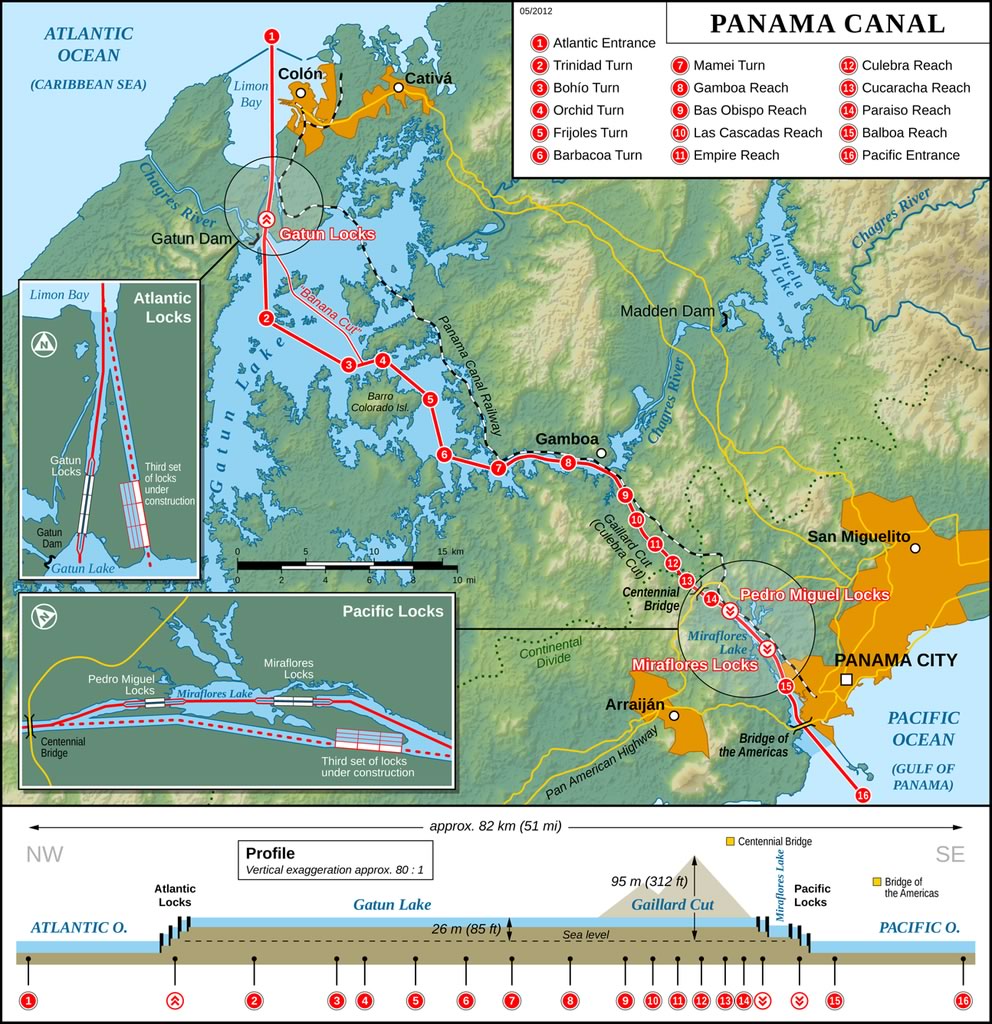
Ever since the Spaniard Vasco Núñez de Balboa's "discovery" of the Pacific Ocean in 1513, Europeans had dreamed of an oceanic shortcut linking the Atlantic to the Pacific. The Panama Canal, built by the U.S. government from 1903 to 1914, realized that vision at the cost of $352 million and, by official count, 5,609 lives from accidents and disease (including some 4,500 black West Indian laborers). The canal, which extends from Colón on the Caribbean side to Panama City on the Pacific, traverses 77 kilometers through three sets of locks.

One of the most remarkable technological feats in world history and far and away the largest engineering project ever undertaken up to that time, the Panama Canal transformed markets, demographics, geopolitics, and national histories in the Western Hemisphere in myriad ways. After 1902, protection of exclusive U.S. rights to a transisthmian canal was the pivot upon which U.S. policy in the Caribbean and Central America turned.

The many episodes of U.S. military, political, and economic intervention in the first three decades of the 20th century can be traced, directly or indirectly, to larger U.S. economic and geostrategic interests centered on the Panama Canal.


For many years, the Panama route had been considered impractical due to the elevation of the continental divide. That the canal ended up being built in Panama and not in Nicaragua resulted from a highly unlikely combination of circumstances, including a bloody three-year civil war in Colombia and its province of Panama (1899–1902); the 1901 assassination of President William McKinley; the imperialist inclinations of McKinley's vice president and successor, Theodore Roosevelt; and an intensive last-minute campaign by the "Panama lobby" in the halls of the U.S. Congress.

The building of the canal in Panama capped more than half a century of various schemes for an interoceanic route that intensified with the U.S. victory in the Mexican-American War (1846–48) and the California gold rush of 1848–49.

In 1850 the U.S. and British governments signed the Clayton-Bulwer Treaty, in which both countries agreed (without consulting Nicaragua) that neither would exercise exclusive rights to the proposed Nicaragua canal.

The 1850s saw two land routes built across Central America: the Panama Railroad (completed in 1855) and the Nicaragua route, brainchild of Cornelius Vanderbilt and his Accessory Transit Company (in service from 1851 to 1856).

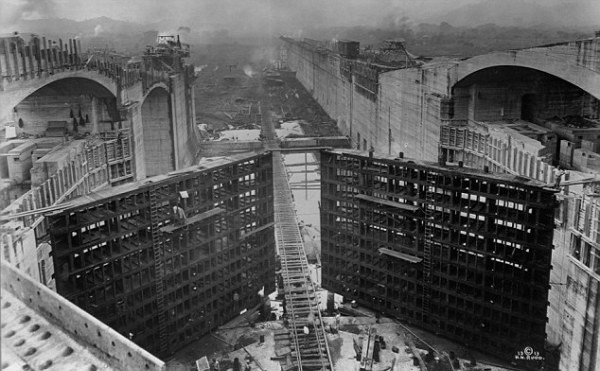
Panama Canal construction

Serious surveying work for a transisthmian canal route began in the 1870s by two different groups: a French syndicate and the U.S. government. In 1878 the Colombian government granted canal rights to a French consortium under the direction of Ferdinand de Lesseps.

Construction commenced in 1881, but by 1889 disease, cost overruns, and related problems led to the firm's bankruptcy and the project's abandonment. As many as 20,000 workers died during the eight-year fiasco.

In 1901 a U.S. commission unanimously recommended the Nicaragua route. In that same year the U.S. and British governments signed the Hay-Pauncefote Treaty, abrogating the 1850 Clayton-Bulwer Treaty and granting the United States exclusive rights to the proposed Nicaragua canal.


The 1902 U.S. decision to build the canal in Panama shocked and dismayed the Nicaraguan elite, who had been convinced that the canal would be built in their country. In January 1903 U.S. and Colombian negotiators signed the Hay-Herrán Treaty, granting the U.S. government a strip of land across Panama for the proposed canal in exchange for $10 million and $250,000 per year thereafter.

The Colombian senate rejected the treaty. President Roosevelt, infuriated by those he termed the "contemptible little creatures ... the Bogotá lot of jackrabbits," engineered a rebellion by dissident elements in Panama. The rebels declared independence on November 3, 1903.

Three days later the Roosevelt administration recognized the breakaway republic. On November 17 the two nations signed the Hay-Bunau-Varilla Treaty, granting the United States exclusive and perpetual control of the canal zone under the same terms as the scuttled Hay-Herrán Treaty with Colombia. As Roosevelt later declared, "I took the Canal Zone."

Actual construction commenced in 1907, and the canal opened on August 15, 1914. In 1921 the U.S. government agreed to pay Colombia $25 million in exchange for Colombian recognition of Panama's independence.

In September 1977 U.S. president Jimmy Carter and Panama chief of government Omar Torrijos signed the Panama Canal Treaty, relinquishing U.S. control of the canal to Panama by the year 2000. Panama assumed formal control of the canal at noon on December 31, 1999. The technical, diplomatic, and geopolitical aspects of the Panama Canal have spawned a vast literature.