Showing posts with label british. Show all posts

All-India Muslim League

Flag of All India Muslim League

The All-India Muslim League (AIML) was established on December 30, 1906, at the time of British colonial rule to protect the interests of Muslims. Later it became the main vehicle through which the demand for a separate homeland for the Muslims was put forth. The Indian National Congress (INC) was perceived by some Muslims as an essentially Hindu organization where Muslim interests would not be safeguarded.

Formed in the year 1885, the INC did not have any agenda of separate religious identity. Some of its annual sessions were presided over by eminent Muslims like Badruddin Tyabji (1844–1906) and Rahimtulla M. Sayani (1847– 1902).

Certain trends emerged in the late 19th century that convinced a sizable group of Muslims to chart out a separate course. The rise of communalism in the Muslim community began with a revivalist tendency, with Muslims looking to the history of Arabs as well as the Delhi sultanate and the Moghul rule of India with pride and glory.

Although the conditions of the Muslims were not the same all over the British Empire, there was a general backwardness in commerce and education. The British policy of "divide and rule" encouraged certain sections of the Muslim population to remain away from mainstream politics.

The INC, although secular in outlook, was not able to contain the spread of communalism among Hindus and Muslims alike. The rise of Hindu militancy, the cow protection movement, the use of religious symbols, and so on alienated the Muslims. Syed Ahmed Khan's (1817–98) ideology and political activities provided a backdrop for the separatist tendency among the Muslims. He exhorted that the interests of Hindus and Muslims were divergent.

Khan advocated loyalty to the British Empire. The viceroy Lord Curzon (1899–1905) partitioned the province of Bengal in October 1905, creating a Muslim majority province in the eastern wing. The INC's opposition and the consequent swadeshi (indigenous) movement convinced some Muslim elites that the congress was against the interests of the Muslim community. 

A pro-partition campaign was begun by the nawab of Dhaka, Khwaja Salimullah Khan (1871–1915), who had been promised a huge amount of interest-free loans by Curzon. He would be influential in the new state. The nawab began to form associations, safeguarding the interests of the Bengali Muslims. He was also thinking in terms of an all-India body. In his Shahbag residence he hosted 2,000 Muslims between December 27 and 30, 1906.

At the All India Muslim League Working Committee, Lahore session, March 1940

Sultan Muhammad Shah, the Aga Khan III (1877– 1957), who had led a delegation in October 1906 to Viceroy Lord Minto (1845–1914) for a separate electorate for the Muslims, was also with Salimullah Khan. Nawab Mohsin-ul-Mulk (1837–1907) of the Aligarh movement also was present in Dhaka. On December 30 the AIML was formed.

The chairperson of the Dhaka conclave, Nawab Viqar-ul-Mulk (1841–1917), declared that the league would remain loyal to the British and would work for the interests of the Muslims. The constitution of the league, the Green Book, was drafted by Maulana Muhammad Ali Jouhar (1878–1931).

The headquarters of the league was set up in Aligarh (Lucknow from 1910), and Aga Khan was elected the first president. Thus, a separate all-India platform was created to voice the grievances of the Muslims and contain the growing influence of the Congress Party. The AIML had a membership of 400, and a branch was set up in London two years afterward by Syed Ameer Ali (1849–1928).

The league was dominated by landed aristocracy and civil servants of the United Provinces. In its initial years it passed pious resolutions. The leadership had remained loyal to the British Empire, and the Government of India Act of 1909 granted separate electorates to the Muslims.

A sizable number of Muslim intellectuals advocated a course of agitation in light of the annulment of the partition of Bengal in 1911. Two years afterward the league demanded self-government in its constitution. There was also change in leadership of the league after the resignation of President Aga Khan in 1913. Mohammad Ali Jinnah (1876–1948), the eminent lawyer from Bombay (now Mumbai), joined the league.

Driving Out the British

Hailed as the ambassador of "Hindu-Muslim unity," Jinnah was an active member of the INC. He still believed in cooperation between the two communities to drive out the British. He became the president of the AIML in 1916 when it met in Lucknow. He was also president between 1920 and 1930 and again from 1937 to 1947.

Jinnah was instrumental in the Lucknow Pact of 1916 between the congress and the league, which assigned 30 percent of provincial council seats to Muslims. But there was a gradual parting of the ways between the INC and the AIML. The appearance of Mohandas K. Gandhi (1869–1948) on the Indian scene further increased the distance, as Jinnah did not like Gandhi's noncooperation movement.

The short-lived hope of rapprochement between the two parties occurred in the wake of the coming of the Simon Commission. The congress accepted the league's demand for one-third representation in the central legislature. But the Hindu Mahasabha, established in 1915, rejected the demand at the All Parties Conference of 1928. The conference also asked Motilal Nehru (1861–1931) to prepare a constitution for a free India.

The Nehru Report spelled out a dominion status for India. The report was opposed by the radical wing of the INC, which was led by Motilal's son Jawaharlal Nehru (1889–1964). The league also rejected the Nehru Report as it did not concede to all the league's demands. Jinnah called it a parting of the ways, and the relations between the league and the congress began to sour.

The league demanded separate electorates and reservation of seats for the Muslims. From the 1920s on the league itself was not a mass-based party. In 1928 in the presidency of Bombay it had only 71 members. In Bengal and the Punjab, the two Muslim majority provinces, the unionists and the Praja Krushsk Party, respectively, were powerful.

League membership also did not increase substantially. In 1922 it had a membership of 1,093, and after five years it increased only to 1,330. Even in the historic 1930 session, when the demand for a separate Muslim state was made by President Muhammad Iqbal (1877–1938), it lacked a quorum, with only 75 members present.

After coming back from London, Jinnah again took the mantle of leadership of the league. The British had agreed to give major power to elected provincial legislatures per the 1935 Government of India Act. The INC was victorious in general constituencies but did not perform well in Muslim constituencies.

Many Muslims had subscribed to the INC's ideal of secularism. It seemed that the two-nation theory, exhorting that the Hindus and Muslims form two different nations, did not appeal to all the Muslims. The Muslims were considered a nation with a common language, history, and religion according to the two-nation theory.

In 1933 a group of Cambridge students led by Choudhary Rahmat Ali (1897–1951) had coined the term Pakistan (land of the pure), taking letters from Muslim majority areas: Punjab P, Afghania (North-West Frontier Province) A, Kashmir K, Indus-Sind IS, and Baluchistan TAN. The league did not achieve its dream of a separate homeland for the Muslims until 1947.

It had been an elite organization without a mass base, and Jinnah took measures to popularize it. The membership fees were reduced, committees were formed at district and provincial levels, socioeconomic content was put in the party manifesto, and a vigorous anti-congress campaign was launched. The scenario changed completely for the league when in the famous Lahore session the Pakistan Resolution was adopted on March 23, 1940.

Jinnah reiterated the two-nation theory highlighting the social, political, economic, and cultural differences of the two communities. The resolution envisaged an independent Muslim state consisting of Sindh, the Punjab, the North-West Frontier Province, and Bengal. The efforts of Jinnah after the debacle in the 1937 election paid dividends as 100,000 joined the league in the same year.

There was no turning back for the league after the Pakistan Resolution. The league followed a policy of cooperation with the British government and did not support the Quit India movement of August 1942. The league was determined to have a separate Muslim state, whereas the congress was opposed to the idea of partition.

Reconciliation was not possible, and talks between Gandhi and Jinnah for a united India in September 1944 failed. After the end of World War II, Great Britain did not have the economic or political resources to hold the British Empire in India. It decided to leave India finally and ordered elections to central and provincial legislatures.

The league won all 30 seats reserved for Muslims with 86 percent of the votes in the elections of December 1945 for the center. The congress captured all the general seats with 91 percent of the votes. In the provincial elections of February 1946, the league won 440 seats reserved for Muslims out of a total of 495 with 75 percent of the votes.

Flush with success, the Muslim members gathered in April for the Delhi convention and demanded a sovereign state and two constitution-making bodies. Jinnah addressed the gathering, saying that Pakistan should be established without delay.

It would consist of the Muslim majority areas of Bengal and Assam in the east and the Punjab, the North-West Frontier Province, Sind, and Baluchistan in the west. The British government had dispatched a cabinet mission in March to transfer power. The league accepted the plan of the cabinet mission, but the league working committee in July withdrew its earlier acceptance and called for a Direct Action Day on August 16.

The league joined the interim government in October but decided not to attend the Constituent Assembly. In January 1947 the Muslim League launched a "direct action" against the non–Muslim League government of Khizr Hayat Tiwana (1900–75) of the Punjab.

Partition was inevitable, and the new viceroy, Lord Louis Mountbatten (1900–79), began to talk with leaders from the league as well as the congress to work out a compromise formula. On June 3, 1947, it was announced that India and Pakistan would be granted independence.

The Indian Independence Act was passed by the British parliament in July, and the deadline was set for midnight on August 14–15. The demand of the league for a separate state was realized when the Islamic Republic of Pakistan was born on August 14.

On August 15 Jinnah was sworn in as the first governor-general of Pakistan, and Liaqat Ali Khan (1895–1951) became the prime minister. The new nation had 60 million Muslims in East Bengal, West Punjab, Sind, the North-West Frontier Province, and Baluchistan.

After independence the league did not remain a major political force for long, and dissent resulted in many splinter groups. The Pakistan Muslim League had no connection with the original league. In India the Indian Union Muslim League was set up in March 1948 with a stronghold in the southern province of Kerala.

The two-nation theory received a severe jolt when East Pakistan seceded after a liberation struggle against the oppressive regime of the west. A new state, Bangladesh, emerged in December 1971. In the early 21st century more Muslims resided in India (175 million) than in Pakistan (159 million).

Amritsar Massacre

Amritsar Massacre
Amritsar Massacre

The Amritsar massacre (April 13, 1919) helped many moderate Indian nationalists become fiercely anti-British. The Rowlatt Acts, enacted by the British government, had outraged politically minded Indians.

Extending wartime emergency legislation, the Rowlatt Acts gave the British viceroy in India the authority to silence the press, make arrests without a warrant, and imprison without trial. The Indian members of the viceroy's legislative assembly opposed this legislation, and several of them resigned (including Mohammad Ali Jinnah, later the founder of Pakistan).

To protest the Rowlatt Acts, Mohandas K. Gandhi called for a national hartal, a day of prayer and fasting, that on April 6 closed most shops and businesses in the northwestern province of the Punjab. The British administration in the Punjab, headed by Sir Michael O'Dwyer, was notoriously stern, and the province had long seethed with unrest.

In Lahore there were large anti-British demonstrations and a railroad strike. On April 10, on O'Dwyer's order, British officials in Amritsar arrested Dr. Saif-ud-Din Kitchlew, a Muslim lawyer, and Dr. Satyapal, a Hindu who had served as a medical officer in the British army. They were leaders of the Amritsar nationalist movement.

In the angry reaction against these arrests, violence broke out resulting in destruction of property and looting in Amritsar. Five British civilians and 10 Indians were killed. A school superintendent, Marcella Sherwood, was trapped by a mob, badly beaten, and left for dead. This mistreatment of a British woman outraged officials.

The villain in the story of the Amritsar massacre was Reginald E. H. "Rex" Dyer. Dyer was a colonel who held the temporary rank of brigadier general while commanding an infantry brigade in the Punjab. Born in India, he was competent in several Indian languages, including Hindi and Punjabi. Before the Amritsar massacre, he had not had a reputation of being more racist than other British officers.

In fact, early in 1919 he had resigned from the officers' club that served his brigade because he objected to the exclusion of Indians who held commissions as officers. He appears to have been lacking in self-confidence while at the same time being stubborn and rash. He did not always obey orders. Unfortunately, he was stationed near Amritsar.

Apparently, Dyer acted on his own initiative in moving his brigade to Amritsar on April 11. On the next day he reissued an earlier government order that banned any meetings or gatherings.

Amritsar Massacre painting

He did not continue the previous policy of slowly extending British military and police control over one part of the city after another. He preferred to parade large forces through Amritsar as a demonstration of strength and then withdraw them.

Despite the proclamations against meetings, thousands of Indians flocked to the Jallianwala Bagh on April 13, most of them in support of the imprisoned Kitchlew and Satyapal. Some arrived after the police had closed a nearby fair held in honor of the Sikh new year. By late afternoon a huge throng was present, a rather quiet crowd and not an angry mob.

Estimates vary, but there certainly were more than 10,000 people. The Bagh was a trap for them. Enclosed by the walls of surrounding buildings, it had only a few narrow openings for entrance or exit, some of them locked.

Dyer made no attempt to prevent the meeting at the Jallianwala Bagh or to disperse it peacefully. He decided to make an example of those who had violated the British prohibition of large gatherings.

For this purpose he assembled a small force of 90 men that included no British soldiers. Instead he chose Baluchis, Gurkhas, and Pathans, "native" soldiers but ones who lacked sympathy for local Indians.

He brought with him two armored cars equipped with machine guns. He later said that he did not use them because the entrances to the Bagh were too narrow. Even without the machine guns, the carnage was great. Without any warning Dyer's soldiers fired on the crowd for 10 to 15 minutes.

There was only one exit available for the thousands. In desperation many of those in the Bagh jumped into a deep well. After his troops had fired 1,650 rounds, Dyer ordered an end to the slaughter because he feared that his men would run out of ammunition and not be able to protect their withdrawal.

Nobody knows how many people were killed. An official estimate made by the British authorities says 379. An Indian investigation says 530. The wounded numbered over 1,000.

After the facts of the massacre became known, Dyer was dismissed. He returned to Britain, where a special commission of investigation censured him in 1920. Despite the official censure, some in Britain saw Dyer as a hero who took decisive action to prevent a rebellion that might have shaken British rule throughout the subcontinent.

For many members of the upper and middle classes and military officers, Dyer was a victim of the government's need to appease Indian nationalists. Dyer died of natural causes in 1927. An embittered Indian assassinated O'Dwyer in 1940.

Balfour Declaration

Balfour Declaration effect

The Balfour Declaration was a statement by the British government regarding Zionist aspirations for the creation of an independent Jewish state in Palestine. The statement took the form of a public letter from Lord Arthur James Balfour, the British foreign secretary, to Lord Rothschild, a prominent British Zionist and member of the renowned banking family.

After many preliminary drafts the final statement, issued on November 2, 1917, read that His Majesty's government viewed "with favour the establishment in Palestine of a national home for the Jewish people."

It went on to say that the British government would use its "best endeavours" to achieve that goal and that nothing should be done to prejudice "the civil and religious rights of existing non-Jewish communities in Palestine, or the rights and political status enjoyed by Jews" in other nations.


Chaim Weizmann, a leading figure in the World Zionist Organization and a skillful diplomat, had been instrumental in securing British support for a Jewish state. Weizmann was a personal friend of Balfour's and had met with many key British officials to gain their sympathy for a Jewish state.

There were many motivations for the British to issue the Balfour Declaration in 1917. Some Christian Zionists supported a Jewish state for religious and moral reasons. But most government officials supported the declaration for political and wartime reasons.

It was hoped that the declaration would encourage Russia to stay in the war in spite of the revolutionary upheaval at the time. Some also thought the statement would prod the United States, where some key Zionists, especially Louis Brandeis of the Supreme Court, had important positions, to enter the war.

However, the arguments that a Jewish state would support Britain in the Middle East and help to protect the vital Suez Canal were probably paramount in convincing many in the British cabinet to support the declaration.

Because most people in the West knew little or nothing about Palestine, many assumed that there were only a few non-Jews in Palestine and that their civil and religious (but not political) rights should be protected.

However, in 1917, when the Balfour Declaration was issued, Palestinian Arabs, a mix of Muslims and Christians, made up over 80 percent of the population in Palestine. It was a predominantly agricultural society, and most people lived in settled villages. Palestinian Arabs and Arab nationalists, especially Sherif Husayn, immediately expressed their opposition to the Balfour Declaration.

Sherif Husayn also argued that the statement contradicted the earlier Sherif Husayn– McMahon correspondence regarding the creation of an Arab state. But the Balfour Declaration did not mention the Palestinian Arab population by name, and they remained largely invisible to the Western world.

Interestingly, some Jews also opposed the statement. Sir Edwin Montagu, a British Jew and secretary of state for India, opposed the creation of a Jewish state on the grounds that it would raise problems of dual nationality and might actually increase anti-Semitism.

The Balfour Declaration was a major step forward in the Zionist struggle to create a Jewish state in Palestine. At the Paris Peace Conference after the war, Weizmann used the Balfour Declaration to justify the creation of a Jewish state.

However, neither Arab nor Jewish national aspirations would be realized after the war because the British and French implemented the Sykes-Picot Agreement, which essentially divided the Arab world between the two imperial powers. The division was formalized in the San Remo Treaty, and Britain made key decisions on how to rule its newly gained Arab territories, including Palestine, at the Cairo Conference in 1921.

Boer War

Boer War
Boer War

The Boer War, from 1899 to 1902, was a conflict between Great Britain and the Boers, or Dutch settlers, in South Africa. The Boers were mostly farmers who had settled as early as the 18th century in South Africa. The British wanted to unify their Cape Colony and Natal colonies and the Boer republics of the Orange Free State and the South African Republic.

The discovery of gold in Transvaal in 1886 led more English settlers to South Africa. These new settlers, called Uitlanders by the Boers, raised Boer concerns over the possible loss of valuable farmland to the English, who were predominantly interested in the mineral resources of South Africa.

After British leaders attempted to incite an uprising among the English in Transvaal in the Jameson Raid of 1896, the rift between the British and the Boers widened. As a result, the Boer leader Paul Kruger won the 1898 election as president of the South African Republic.


To undercut possible British moves, the Boers demanded that the British withdraw all their troops; when the ultimatum was rejected, the Boers attacked the Cape Colony and Natal, laying siege to the cities of Kimberley, Mafeking, and Ladysmith. The defense of Mafeking was led by Robert Baden-Powell, the founder of the Boy Scouts. The future prime minister of Britain Winston Churchill also participated in the war, as did the Indian nationalist leader Mohandas K. Gandhi, who served in the British medical corps.

After initial defeats, the British rallied their troops and in 1900 appointed Horatio Herbert Kitchener, who had just successfully taken the Sudan, as the commander in chief. With superior firepower the British army successfully lifted the sieges, but the Boers then resorted to hit-and-run guerrilla warfare tactics, some of which they had learned from the Zulus in earlier confrontations.

Boer leader Paul Kruger

To defeat the Boers, Kitchener adopted techniques that were used against guerrilla fighters throughout the world in the 20th century. These included slash-and-burn attacks against civilian farms and cutting off supplies of food and arms to Boer fighters by placing the civilian population in concentration camps.

Thousands of Boer women and children were rounded up and placed in armed camps, where many starved to death. Their farms were then burned to the ground, thereby depriving the Boer fighters of cover and food supplies. Many indigenous Africans were also placed in camps.

Boer militiamen
Boer militiamen

Some were sent to camps in Bermuda, India, and St. Helena. Almost 30,000 Boers, mostly women and children, and 14,000 Africans died in the camps. The destruction of much of the countryside also led to food shortages. In the spring of 1902 the Boers were forced to accept defeat. Under the Treaty of Vereeniging all of South Africa became part of the British Empire.

British Mandate in Palestine

British Mandate in Palestine

Although British control of Palestine started on December 11, 1917, the Palestine mandate was not approved by the council of the League of Nations until July 24, 1922, through the Treaty of San Remo. The mandate was formally established on September 29, 1923.

Some of the causes of the delay were uncertainties about the territorial boundaries of the new entity and the issue of the contradictory future obligations of the Mandatory Power. The land's symbolic and political significance by far exceeded its local or even regional importance.

The historical cradle of the Jewish people and the holy land of Christianity, Palestine had for many centuries been inhabited by a mainly Muslim and Arab speaking population. Since the beginning of the 20th century the Zionist movement, established at the congress at Basel in 1897, sought to recreate there the Jewish national home, but up until World War I it still had no international recognition and only limited Jewish support.


During World War I on November 2, 1917, the British foreign secretary, Arthur James Balfour, seeking Jewish international support, issued a declaration assuring his government's support for the establishment in Palestine of the Jewish national home.

The Palestine mandate copied the text of the Balfour Declaration, as both Britain and the League of Nations apparently believed that building a Jewish national home and protecting the Arab majority's rights and position were not incompatible objectives.

The Palestine mandate received by Britain in 1920 included the future Transjordan, but this was transformed into a separate territorial unit. The Emirate of Transjordan, never considered part of historic Palestine, was explicitly excluded from the area of Palestine designed as the Jewish national home.

In this framework of the Palestine mandate the Jews enjoyed numerous advantages over the local Arab Palestinian population. With the help of worldwide Jewish communities and the British government the Zionists made enormous progress in developing an up-to-date economic, social, and political system.

Their numbers increased quickly because of growing immigration, from 83,790 in 1922 to 174,606 in 1931, and were estimated at 528,702 in 1944; they grew from 12 percent of the total population in 1922, to about 17 percent in 1931, to about 31 percent in 1944.

In spite of that, the Jewish population remained a minority and would not have achieved their goals and aspirations without constant British military and security guarantees and protection. In practice the British granted considerable autonomy to the various religious groups along the lines of the old Turkish millet system and intended to prevent the development of the national-minded Palestinian Arab ethnic community.

Lack of self-rule institutions and elected representatives deprived the Palestinian population of many political chances in the future. Led mainly by the clan (hamula) and big land-owning families, the Palestinian population in the country by 1936 had increased to about 1 million, primarily as the result of a high birth rate.

The British government started to introduce limitations on Jewish immigration to Palestine, but these quotas and the very concept of the absorptive capacity of the country became controversial, particularly in the 1930s and early 1940s.

The situation in Palestine deteriorated largely under the impact of external factors, which included the Great Depression and Hitler's assumption of power in 1933 followed by the Nazi regime in Germany. Legal and illegal Jewish immigration to Palestine increased dramatically, from 9,553 in 1932 to 61,854 in 1935, because of which Arab-Jewish relations became tenser.

Even before that, especially in 1921 and 1929, there had been violent clashes between the two communities. The Jewish Self-Defense Force, Haganah, was formed on June 15, 1920, and eventually evolved into the Israeli Defense force (IDF).

Between 1936 and 1939 there was the great Arab uprising, directed predominantly against the British mandatory power but also against Zionist settlers. The revolt began with a general strike that lasted some six months and soon evolved into a large-scale peasant revolt that mobilized the entire Palestinian Arab population.

Almost 1,000 Palestinians and 80 Jews were killed in the first year, and by 1939 the British military had either killed or imprisoned most of the key Palestinian leaders. The revolt considerably weakened Palestinian political and military organizations and caused the loss of key leaders who might have been effective after World War II in the ongoing Arab-Israeli conflict.

The British also tried to find a political solution to the existing dilemma of conflicting Zionist and Palestinian demands for national control over the same territory. In 1936 the Peel Commission was sent to Palestine, and in 1937 it concluded that the mandate was unworkable in its present form.

The Peel Commission recommended the partition of Palestine into a Jewish state, a Palestinian area to be merged with Transjordan, and Jerusalem and its neighborhood remaining under direct British control. The partition plan was opposed by both sides.

In May 1939 the Statement of Policy on Palestine replaced the partition plan with new directives. The British government declared that it wanted to establish "an independent Palestine State." This state was to be established within 10 years.

During that period Jewish immigration would be limited to 15,000 per year during the first five years, after which no further Jewish immigration without Arab consent would be allowed. In 90 percent of Palestine, the transfer of Arab lands was forbidden or restricted.

Predictably, the most negative reaction came from the Zionist and Jewish circles, who dubbed it the "Black Paper." The most radical wing of the Zionist movement, the revisionists, almost immediately initiated violent actions against the British administration and the Arabs.

The smuggling of arms and illegal immigrants into Palestine had begun before 1939, but it continued and intensified after that. Between 1939 and 1943 about 20,000 illegal Jewish immigrants and 19,000 legal ones entered the country.

After World War II several factors, such as U.S. support for the Zionist cause, the decline of British economic and political power, and the impact of the Holocaust on world opinion persuaded the British to submit the Palestine question to the United Nations on April 12, 1947.

On May 15, 1948, the British mandate was terminated, and the British evacuated their troops from Palestine. Caught between conflicting obligations and facing the decline of their own power, the British had no choice but to leave.

Cairo Conference (1921)

Cairo Conference (1921)

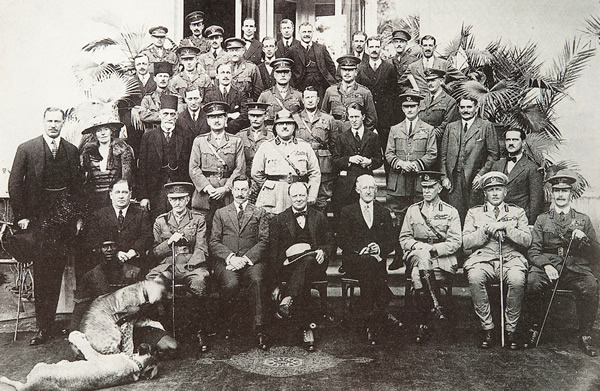
The Cairo Conference was convened by the British to decide how to govern their newly gained Arab territories after World War I. Opening in March 1921, the conference represented a virtual who's who of British experts on the Middle East from the foreign office and the military.

Lawrence of Arabia (T. E. Lawrence), champion of the Arab revolt; Gertrude Bell, an expert on Iraqi tribes and politics; as well as Sir Percy Cox, high commissioner for Iraq, and Sir Herbert Samuel, high commissioner for Palestine, all participated. The conference was chaired by Winston Churchill, then secretary of state for the colonies.

The San Remo Treaty in 1920 had formalized British control over Iraq and Palestine, formerly territories of the now-defunct Ottoman Empire. However, the British had been caught off guard by the 1920 violent revolt against their occupation of Iraq. If possible, they wanted to avoid future confrontations that necessitated the deployment of British or imperial troops and that placed heavy financial burdens on the British treasury.


At the conference it was agreed that a plebiscite should be held in Iraq to elect a king who would rule in close conjunction with British advisers. Faysal, Sherif Husayn's son and a favorite of the British, was proposed as the British nominee. After some hesitation he accepted the position. Faysal won subsequent elections that were held under British supervision, and he duly became the king of Iraq.

His heirs continued to rule Iraq until they were overthrown in a violent militaryled revolution in 1958. The installation of an Arabled government made Iraq ostensibly independent, and it was ultimately granted entry into the League of Nations. But Iraq remained linked with Britain by a treaty that granted Britain extensive control over its foreign affairs and allowed the British military access whenever it chose.

Faysal's older brother Abdullah was selected to become amir (prince) and ultimately king of the land east of the River Jordan. Churchill coined this new entity, Transjordan, meaning on the other side of the Jordan.

Cairo Conference map

Abdullah was dependent on Britain for economic and military support, and his main military force, the Arab Legion, was led by a British military officer. This territory ultimately became the Hashemite monarchy in Jordan under the rule of Abdullah and his heirs.

His great grandson, Abdullah II, ruled Jordan in the early 21st century. The creation of allegedly independent countries was meant to assuage Sherif Husayn and Arab demands that the promises regarding Arab independence after the war seemingly made by the British in the Sherif Husayn–McMahon correspondence be met.

In Palestine the British retained direct political and military control and assured their security concerns in the region, especially the protection of the vital Suez Canal. During the interwar years the British retained their preeminent position while attempting, with various degrees of success, to balance the conflicting national demands of the Palestinian Arabs for an independent Arab state and the Zionists for an independent Jewish state.


The British mandate in Palestine lasted until after World War II, when the British could no longer economically or militarily afford to maintain order in Palestine, and they consequently turned over the entire issue of who should rule Palestine to the newly formed United Nations.

The decisions made at the Cairo Conference failed to satisfy either Arab or Zionist demands for self-determination. They also formalized the division of the Arab territories into separate nations ruled by regimes established and in large part maintained by the British. The nationalist hostility and resentment fostered throughout the Arab world by the actions taken at the Cairo Conference lasted throughout the 20th century.

Joseph Ephraim Casely Hayford

Joseph Ephraim Casely Hayford
J. E. Casely Hayford made enormously important contributions to the theory of Pan-Africanism and organized the National Congress of British West Africa. Casely Hayford became an inspiration for Ghana's independence movement leader and first president, Kwame Nkrumah, though Nkrumah's generation no longer accepted the British presence in the way that Casely Hayford and his colleagues had.

Born in 1866, the man whom many would later describe as the "uncrowned king of West Africa" enjoyed educational opportunities in Africa and in England. He completed his secondary education at a Wesleyan (Methodist) boys' high school in Cape Coast, the major port in the colony known to the British as the Gold Coast. He spent several years as a teacher and principal in Wesleyan schools in both Accra (Nigeria) and Cape Coast.

Following an apprenticeship to a European lawyer, he traveled to London in 1893 to become a lawyer himself. He completed legal training in 1896 and soon returned to Cape Coast, where he established an active, admired private practice.

Casely Hayford largely identified himself with other professional, European-educated black Africans, but he did not forget the traditions and worldview characteristic of the Fanti. During his youth Casely Hayford's father had participated in protests against the British erosion of native autonomy and customs, particularly with regard to land distribution and usage.

This early exposure to political activism and to debates about the virtues (and flaws) of traditional, as opposed to British, law prepared Casely Hayford to become involved in the activities of the Aboriginal Rights Protection Society (ARPS) that formed at the end of the 19th century.

Shortly after the introduction of the 1897 Lands Bill into the British parliament, traditional elites and intellectuals of the Gold Coast joined together in the ARPS to resist this proposed introduction of British property laws. Casely Hayford and John Mensah Sarbah supported the ARPS's effort by authoring pamphlets that explicated the traditional systems and presented cogent arguments against the Lands Bill.

Over the next few decades, he augmented his already strong reputation by publishing several books that revealed his intelligence and his passionate commitment to achieving prosperity in Africa. Gold Coast Native Institutions, published in 1903, dealt with the issues at stake in the Lands Bill controversy.

He asserted that these societies already possessed democratic institutions and a high degree of civilization. He thought of native institutions as an asset, not a liability, in the quest for progress and modernization.

In his 1911 autobiographical novel, Ethiopia Unbound: Studies in Race Emancipation, Casely Hayford provided a fictionalization of Pan-Africanist themes and ideals. By evoking the achievements and influence of the "Ethiopian" (in Pan-Africanist ideology, this signified all Africans and not just the inhabitants of a particular country in Africa), Casely Hayford boasted that the African could feel proud of his heritage despite the various racial theories that cast him as inferior.

The goal of activism should be to encourage the expansion of education, the preservation of indigenous customs where they proved durable and useful, and the unification of Africans both within a single colony and within a region governed by a single imperial power. Eventually, this unity should extend across Africa and would reap tremendous economic, political, and cultural benefits for all Africans as they strived to modernize.

In keeping with his ideology, Casely Hayford worked to organize the National Congress of British West Africa in the years immediately following World War I. The group met for the first time in 1920, and Casely Hayford became its vice president.

The congress's agenda of promoting economic development, education, and democratic institutions without seeking complete independence from Britain reflected Casely Hayford's own hopes. He expected that British West Africa would become the continent's leader in the overall effort to modernize.

Future generations might criticize Casely Hayford for his gradualism and willingness to accept British rule. Even when frustrated by British intransigence, he never resorted to violence or other radical tactics that might have gotten results.

Despite his relatively few concrete achievements, he became the leader of his generation and urged his fellow citizens to prepare to govern themselves and to take pride in their culture and traditions.

Winston Churchill

Winston Churchill
Winston Churchill

Sir Winston Leonard Spencer Churchill, one of the greatest prime ministers of Great Britain and Nobel laureate for literature, was born on November 30, 1874, in Oxfordshire. He studied at Harrow and the Royal Military College at Sandhurst. With intermingling careers in the army and in journalism, he traveled to Cuba, the North-West Frontier in India, Sudan, and South Africa.

His political career began as a member of the House of Commons in 1900. After the electoral victory of the Liberals in 1906, Churchill became the undersecretary of state for the colonies. He also became the president of the Board of Trade and afterward the home secretary, undertaking major social reforms.

In 1911 he was appointed lord of the admiralty in the ministry of Herbert Asquith (1852–1928) and undertook modernization of the Royal Navy. An abortive naval attack on the Ottoman Turks and the Allied defeat at Gallipoli led to Churchill's resignation at the time of World War I.


He was called back and was put in charge of munitions production in the ministry of David Lloyd George (1863–1945) and was instrumental in deploying tanks on the western front. He returned to the Conservative Party as chancellor of the exchequer in 1924 in the ministry of Stanley Baldwin (1867–1947). He reintroduced the gold standard in his tenure of five years.

For about a decade he did not hold any ministerial office and was isolated politically because of his extreme views. Most of the political leaders also did not pay any heed to Churchill's caution against appeasement policy toward Germany and the German march toward armament.

For Prime Minister Neville Chamberlain (1869– 1940) the policy of appeasement toward Nazi Germany was not working. There was no relenting of the march of Germany's army under Adolf Hitler (1889–1945). Churchill became the premier on May 13, 1940, when he also took charge of the Department of Defense.

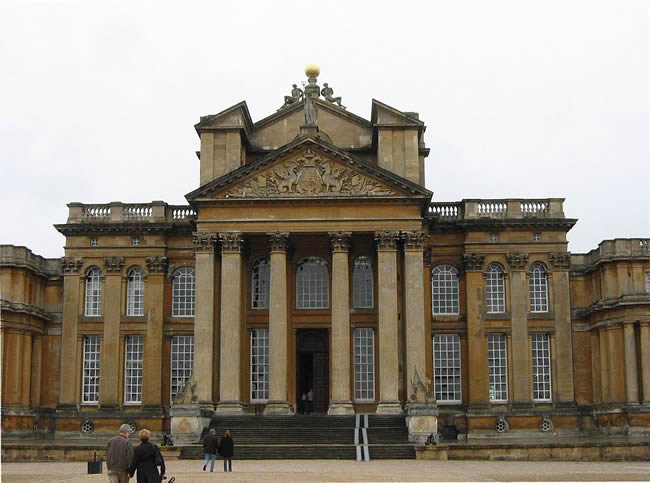
Blenheim Palace, the Churchill family home

As wartime policy, he initiated measures that enabled the country to withstand the Nazi onslaught and led Great Britain toward victory. However, the bombing of German cities, particularly the firebombing of Dresden, which resulted in the loss of thousands of innocent lives, brought criticism against him.

Churchill initiated changes in the war efforts of his government. For the Air Raid Precautions (ARP), half a million volunteers were enlisted. Under the National Services Act, conscription and registration of men between 18 and 41 began. In 1944 the British army had a strength of about 2,700,000.

Women's emancipation took another step when they were called upon to work outside the home in the war economy. Agencies like the Women's Transport Service (FANY), the Women's Auxiliary Air Force (WAAF), the Auxiliary Territorial Service (ATS), and the Women's Royal Naval Service were created, by which women contributed to the nation's war efforts.


Churchill, along with the Soviet leader Joseph Stalin and Franklin Delano Roosevelt, formulated war strategy, peace plans, the reconstruction of Europe, and the fate of the Axis powers. Churchill had met Roosevelt on August 14, 1941, and signed the "Atlantic Charter," which spelled out a plan for international peace and adherence to national sovereignty.

The "Grand Alliance" was committed to defeating Nazism and bringing about world peace. The last wartime conference that Churchill attended was the Yalta Conference in Crimea in the Soviet Union (now in Ukraine) with Roosevelt and Stalin between February 4 and 11, 1945.

The differences between the Soviet Union on the one hand and the United States and Great Britain on the other were emerging. Churchill had many rounds of verbal dueling with Stalin over the fate of Poland, the division of Germany, and the occupation of Berlin. Once the war was over and their common enemy was defeated, the cold war began.

World War II ended in victory, but Great Britain was no longer the country commanding the most military and economic clout in the world. It was in debt £4.198 billion, and the cost of living had increased by 50 percent. Churchill's Conservative Party was defeated in the elections of July 1945, and the Labour Party under Clement Attlee (1883–1967) came to power.

Disillusionment with the Conservative Party, Churchill's neglect of the health and educational sectors, and economic woes contributed to the Conservative defeat. Churchill was the leader of the opposition in the House of Commons. He was relentless in turning public opinion against international communism.

His speech delivered on March 5, 1946, at Westminster College in Fulton, Missouri, was a clarion call to the West to be ultra careful against communism. He called for an alliance of the Englishs peaking peoples of the world before it was too late. This "iron curtain" speech was regarded as the beginning of the schism between the East and the West and the division of the world into two blocs.

With the return of the Conservative Party to power in Britain, Churchill became the prime minister as well as the minister of defense in October 1951. Great Britain intervened in Iran after its prime minister, Mohammed Mossadegh (1880–1967), nationalized the Anglo Iranian Oil Company (AIOC).

Churchill planned a coup to oust the government with the help of the United States. He dispatched British troops to the colony of Kenya in August 1952 at the time of the Mau Mau Rebellion, which was suppressed. Churchill's administration dealt with the rebellion against British colonial rule in Malaya. Churchill during his first and second premiership was never willing to grant self-government to the colonies.

Although high-sounding words like democracy, national sovereignty, and self-determination had been uttered at the time of World War II by Churchill and other Allied leaders, granting independence to the colonies was not in Churchill's agenda. In fact, he had shown an apathetic attitude toward the Indian freedom movement. The Quit India movement of 1942 was suppressed ruthlessly.

He had lampooned Mohandas K. Gandhi (1869–1948) as a "naked fakir." He was also indifferent to the devastating famine of 1943 in Bengal, which killed about 3 million people. Churchill resigned in April 1955 due to ill health. He continued as a backbencher in the House of Commons until 1964. Churchill died in London on January 24, 1965.

In his lifetime Churchill was bestowed with many honors. He became Sir Winston Churchill after becoming a Knight of the Garter in 1953. For his contribution to European ideals he was awarded the Karlspreis award by the city of Aachen, Germany, in 1956.

The U.S. government made him an honorary citizen in 1963. His writing career began with reports from the battlefield like The Story of the Malakand Field Force (1898) and The River War (1899). He published a biography of his father, Life of Lord Randolph Churchill (1906), and wrote one on his ancestor, Marlborough: His Life and Times (four volumes, 1933–38).

Churchill's The World Crisis (1923–31) was a history of World War I in four volumes. He also wrote History of the English-Speaking Peoples in four volumes (1956–58). In 1953 he was awarded the Nobel Prize in literature for his six-volume work The Second World War (1948–53).